

Inhaltsverzeichnis
| Wir bieten wissenschaftlich fundierte Informationen zu Gesundheit, Ernährung und Nachhaltigkeit – unabhängig von Sponsoren, Lebensmittelindustrie oder Herstellern von Nahrungsergänzungsmitteln. Hier erfahren Sie mehr: unsere Mission. |
Boscs Flaschenbirnen gehören zu den Kernobstgewächsen. Birnen zählen neben dem Apfel zu einer der beliebtesten Obstsorten Europas, v.a. in Bio-Qualität. Die Frucht steckt voller gesundheitsfördernder Stoffe und sie schmeckt roh, getrocknet, gekocht oder konserviert.
Verwendung in der Küche
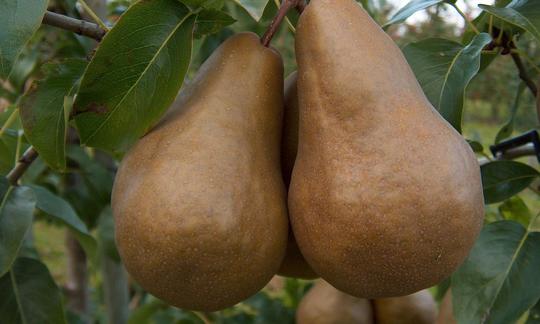
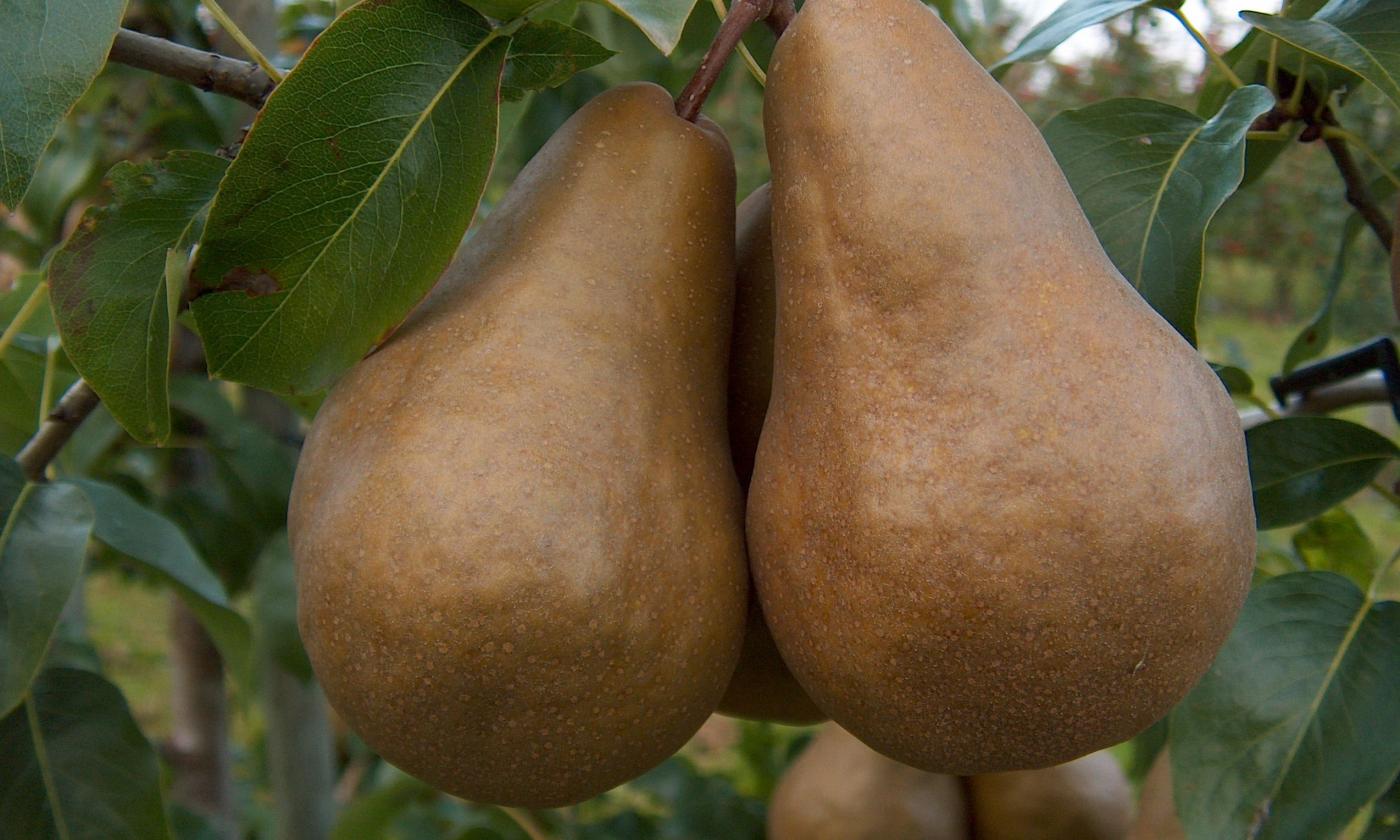
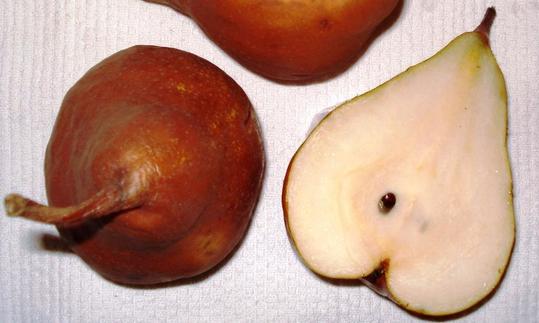
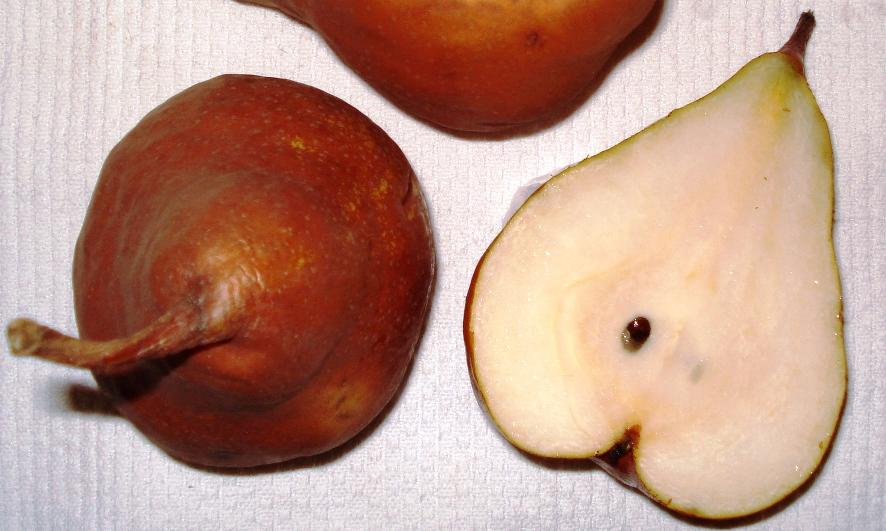
Boscs-Birnen weisen eine raue, grüngelbe Schale mit einer gelbbraunen "Berostung" auf. Das saftige Fruchtfleisch ist weisslich-gelb und weich. Boscs Flaschenbirnen schmecken roh verzehrt sehr süss. Mit einer Höhe von 9 bis 11 cm und einem Durchmesser von 5 bis 7 cm gehören sie zu den mittelgrossen bis grossen Birnensorten.
Birnen haben eine vielfältige Verwendung in Rohkost-Gerichten: im Obstsalat, als Topping für Müsli (z.B. im Erb-Müesli als Ersatz für Apfel), als fruchtige Ergänzung in Smoothies mit Spinat oder in selbst gepressten Säften. Eingekochte Birnen oder Birnenmus verfeinern u.a. Porridge, veganen Milchreis und Griessbrei. Besonders gut schmecken Birnen auch in Kombination mit Zimt oder Kardamom, z.B. für ein Chutney. Gebacken mit Walnüssen ergibt sie ein feines Dessert. Andere schmackhafte Dessertmöglichkeiten mit Birnen sind ein gebackenes Crumble mit Haferflocken oder Kuchen. Gedörrte bzw. getrocknete Birnen bereichern Brot und Gebäck.
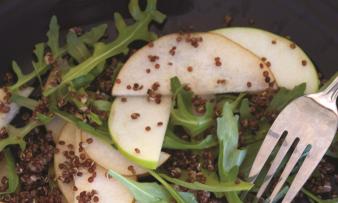
Rohkostsalate geben süssen Birnen eine besondere Note. Sie passen hervorragend zu süsslichen Salaten wie Bataviasalat und Kopfsalat, schmecken jedoch auch lecker mit leicht bitteren oder scharfen Salaten, wie Chicorée und Rucola, z.B. mit Balsamico-Dijon-Dressing.
Veganes Rezept für Birnen-Bananen-Eis
Zutaten (für 4 Personen): 1 Banane, 1-2 Boscs Flaschenbirnen, 3 EL Macadamianüsse, 100 ml Haferdrink, 2 Prisen Vanillepulver.
Zubereitung: Bananen schälen und in Scheiben schneiden. Birnen schälen und in Stücke schneiden. Bananen und Birnen einfrieren. Die gefrorenen Früchte mit Macadamianüssen, Hafermilch und Vanillepulver in ein Gefäss geben und mit einem Hochleistungsmixer schnell zu einer cremigen Eismasse mixen. Das Rohkost-Eis in kleine Schüsseln anrichten und sofort verzehren.
Vegane Rezepte mit rohen Boscs Flaschenbirnen finden Sie unter dem Hinweis: "Rezepte, die am meisten von dieser Zutat haben".
| Nicht nur Veganer oder Vegetarier sollten das lesen: Veganer essen oft ungesund. Vermeidbare Ernährungsfehler. |
Einkauf - Lagerung
Die Erntezeit der meisten in Europa kultivierten Birnen-Sorten ist im Herbst. Die Saison von Boscs Flaschenbirnen ist von Mitte September bis Oktober.3
Wo kann man Boscs Flaschenbirne kaufen? Boscs, eine beliebte Birnen-Sorte im D‑A‑CH‑Raum, gibt es bei Grossverteilern wie Coop, Billa, Migros, Denner, Volg, Spar, Aldi, Lidl, Rewe, Edeka und Hofer. Alnatura oder Denn's Biomarkt führen sie in Bio-Qualität. Oft bieten Landwirte Flaschenbirnen ab Hof oder auf saisonalen Wochenmärkten an.
Achten Sie beim Einkauf frischer Birnen auf eine unversehrte Schale ohne Druckstellen oder Löcher.
Die Verfügbarkeit von Boscs Flaschenbirnen ist je nach Grösse des Ladens, Einzugsgebiet etc. unterschiedlich. Unsere erfassten Lebensmittelpreise für die D-A-CH-Länder finden Sie oben unter dem Zutatenbild - und mit Klick deren Entwicklung bei verschiedenen Anbietern.
Tipps zur Lagerung
Die Produktion von Birnen erfolgt primär für den direkten Konsum, da die Lagerung schwierig ist.2 Im Vergleich zu Äpfeln verderben Birnen schneller und nur ausgewählte Sorten halten mehr als ein paar Monate. Dabei sollten sie, ohne dass sie einander berühren, an einem kühlen, dunklen Ort lagern.7
Da Birnen zu den klimakterischen Früchten gehören, reifen sie nach der Ernte von innen nach aussen weiter. Bei fester Schale, ist das Fruchtfleisch innen oft überreif und mehlig. Zum Einfrieren die Früchte waschen, schneiden und entkernen. So halten sie im Gefrierbeutel bei -18 °C bis zu 10 Monate.
Inhaltsstoffe - Nährwerte - Kalorien
Zusammensetzung und Menge der Inhaltsstoffe, inkl. sekundäre Pflanzenstoffe, variieren extrem je nach Sorte, Wachstumsbedingungen und Verarbeitungsmethoden etc.
Rohe Boscs Flaschenbirnen (bio?) bestehen bis zu 83 % aus Wasser, der Energiegehalt liegt bei 67 kcal/100g. Unter den Nährstoffen sind Proteine und Fett schwach vertreten, der Hauptbestandteil der Energie stammt aus Kohlenhydraten (16 g/100g), davon sind 10 g Zucker. Der Anteil an Ballaststoffen beträgt 3,1 g/100g.1
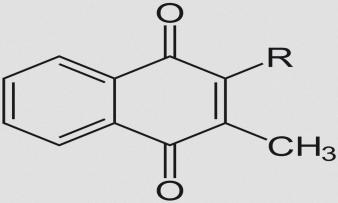
Vitamin K ist mit 5,2 µg/100g in Flaschenbirnen vertreten (ca. 7 % des Tagesbedarfs), was mit Cranberrys vergleichbar ist. Bei Grünkohl decken nur 10 g (705 µg/100g) beinahe den Tagesbedarf des Vitamins.
Boscs sind mit 122 mg/100g eine gute Quelle für Kalium, ein wichtiges Element für den Wasserhaushalt des Körpers. Früchte mit ähnlichen Werten dieses essenziellen Elements sind Apfel (Granny Smith) und Sanddornbeeren. Getrocknete Tomaten (3427 mg), getrockneter Steinpilz (2000 mg) und Sojabohnen (1797 mg/100g) weisen einen wesentlich höheren Anteil an Kalium auf.1
Die Flaschenbirnen enthalten pro 100 g 7 µg Folat (Folsäure), ähnlich wie Rhabarber oder Salatgurken. Neben Hülsenfrüchten haben auch getrocknete Kräuter (z.B. Bärlauch getrocknet 551 µg/100g) hohe Folsäure-Werte.
Die gesamten Inhaltsstoffe von rohen Boscs Flaschenbirnen, die Abdeckung des Tagesbedarfs und Vergleichswerte mit anderen Zutaten finden Sie in unseren Nährstofftabellen. Im Artikel Nährstoffe umfassend erklärt bekommen Sie einen detaillierten Einblick in das Thema.
Wirkungen auf die Gesundheit
Birnen enthalten viele Nährstoffe, darunter Ballaststoffe, Vitamin C und Kalium. Obst besteht überwiegend aus Kohlenhydraten in Form von natürlichen Zuckern und Ballaststoffen. Vergleiche zwischen Äpfeln und Birnen zeigen, dass Birnen höhere Gehalte an Fruktose und Sorbit aufweisen, während Äpfel mehr Glukose und Saccharose enthalten.13,15
Sekundäre Pflanzenstoffe
Viele gesundheitliche Wirkungen von Boscs Flaschenbirne kann man auf die enthaltenen sekundären Pflanzenstoffe zurückführen. Unser Artikel über sekundäre Pflanzenstoffe bietet einen Überblick über die Klassifizierung der Stoffgruppen, das Vorkommen in Lebensmitteln und mögliche Wirkungen auf den Menschen.
Boscs Flaschenbirnen (Schale und Fruchtfleisch) enthalten u.a. folgende sekundäre Pflanzenstoffe:14,15,16
- Isoprenoide: Triterpene (Oleanolsäure, Ursolsäure); Tetraterpene: Carotinoide (Beta-Carotin)
- Polyphenole: Phenolsäuren: Hydroxybenzoesäuren (Gallussäure, Protocatechinsäure), Hydroxyzimtsäuren (Rosmarinsäure, Zimtsäure, Chlorogensäure, Kaffeesäure); Flavonoide: Flavanole (Catechin, Catechin-Derivate, Epicatechin, Epicatechin-Gallat), Flavonole (Rutin, Quercetin-Derivate), Flavanone (Eriodictyol-Derivate), Anthocyane (Cyanidin-Glucosid), Flavonole (Quercetin, Kaempferol); Tannine (Ellagsäure, Procyanidin); Gycoside (Arbutin); Chalkone
Boscs Flaschenbirnen stellen eine reichhaltige Quelle für antioxidative Polyphenole und entzündungshemmende Triterpene (Ursolsäure und Oleanolsäure) dar. Diese liegen sowohl in der Schale als auch im Fruchtfleisch, wobei die Konzentrationen in den äusseren Fruchtbereichen und in der Schale höher ausfallen. Bevorzugen Sie Bio-Birnen, da auch die Schale bedenkenlos verzehrbar ist.17 Boscs Flaschenbirne zeigt in vergleichenden Laboranalysen relativ hohe Gehalte an Polyphenolen, insbesondere an phenolischen Säuren wie Chlorogensäure, und eine sehr hohe antioxidative Kapazität.13,14,15
Phenolische Verbindungen sind u.a. mit einem reduzierten Risiko für Herz-Kreislauf-Erkrankungen, Krebs und Alzheimer verbunden. In Tiermodellen zeigen Procyanidine eine antiulzerogene (gegen Magengeschwüre) Wirkung.13,14,15 Eine Metaanalyse hebt hervor, dass insbesondere der Konsum von Zitrusfrüchten, Äpfeln, Birnen und grünem Blattgemüse mit einem geringeren Schlaganfallrisiko verbunden ist. Epidemiologische Studien zu Flavonoiden und Erkrankungsrisiken beschreiben ein reduziertes Risiko für Typ-2-Diabetes durch den Verzehr von Heidelbeeren, Weintrauben sowie Äpfeln und Birnen.13
Carotinoide kommen in Birnen in eher geringen Mengen vor, ähnlich wie beim Apfel. Carotinoide wirken als Provitamin A, schützen als Antioxidantien, unterstützen die Gesundheit von Augen und Haut und senken das Risiko für Atherosklerose sowie bestimmte Krebsarten.14
Gefahren - Unverträglichkeiten - Nebenwirkungen
Allergische Reaktionen zeigen häufig Menschen, die (in Nordeuropa) auch auf Birkenpollen reagieren. Dabei kommt es 5-15 Minuten nach dem Verzehr zu lokalen Beschwerden wie Kratzen im Mund und Hals. Durch Kochen können Sie das hierbei involvierte Allergen unwirksam machen. In mediterranen Ländern hingegen tritt eine allergische Reaktion auf Birnen eher bei einer Kreuzallergie auf Pfirsiche auf. Als mögliche Symptome gelten Bauchschmerzen oder Erbrechen. Lebensbedrohliche Zustände scheinen bei dieser Form weitaus schwerwiegender.8
Oft gibt es auch Reaktionen auf Äpfel, Aprikosen, Kirschen, Melonen, Bananen, Haselnüsse, Knollensellerie oder Karotten. Gekochte Birnen vertragen Allergiker meist gut, weil das Allergen hohen Temperaturen nicht standhält.8
Birnen enthalten viel Fruktose und Sorbit - grössere Mengen können daher Durchfall auslösen.13
Volksmedizin - Naturheilkunde
In der chinesischen Volksmedizin gilt die Birne als Heilmittel gegen Husten, Verstopfungen und Entzündungen sowie als harntreibendes Mittel.13
Ökologischer Fussabdruck - Tierwohl
Bei Untersuchungen zur Öko-Bilanz unterscheidet man vielfach nicht zwischen den Birnensorten.
Der CO2-Fussabdruck von regionalen Birnen ist mit 0,3 kg CO2eq/kg ähnlich dem von regionalen Äpfeln oder Trauben.10 Importierte Birnen von anderen Kontinenten hingegen schneiden bei der Bewertung des Klimaeffekts dank der hohen Menge CO2 beim Transport mittels Schiff eher schlecht ab.11 Die benötigte Wassermenge zur Produktion von 1 kg Birnen beträgt 922 Liter.12
In der konventionellen Landwirtschaft kommen zur Bekämpfung von Schädlingen oftmals synthetische Pestizide und Herbizide zum Einsatz. Die Tragweite dieser Mittel ist jedoch nicht nur auf einzelne Pflanzen beschränkt, sie wirkt auch negativ auf deren Umgebung. Zusätzlich gibt es Rückstände im Endprodukt. Besonders bei Früchten konnte man hohe Rückstände unterschiedlicher Pestizide feststellen. Um Pestizide in Nahrungsmitteln zu vermeiden, greift man besser auf Obst und Gemüse aus biologischem Anbau zurück, da hier die Nutzung synthetischer Pflanzenschutzmittel untersagt ist.
Ausführliche Erläuterungen zu verschiedenen Nachhaltigkeitsindikatoren (wie z.B. ökologischer Fussabdruck, CO2-Fussabdruck, Wasser-Fussabdruck) lesen Sie in unserem Artikel: Was bedeutet der ökologische Fussabdruck?
Tierschutz - Artenschutz
In der Blütezeit ist der Birnbaum auf Insekten wie Wildbienen oder Honigbienen zur Bestäubung angewiesen, da seine Blüten selbststeril sind. Allerdings sind Birnenblüten sowohl aufgrund der geringen Nektarmenge als auch der chemischen Komposition der Pollen nicht so attraktiv wie Blüten von Äpfeln oder Aprikosen.4
Zwischen den einzelnen Birnenarten gibt es hierbei jedoch Unterschiede, was bei der Auswahl der Arten für Plantagen eine grosse Rolle spielen kann. Eine Untersuchung in China zeigte, dass sowohl die asiatische Honigbiene (Apis cerana) als auch die europäische Honigbiene (Apis mellifera) häufiger die Blüten der europäischen Kulturbirne (Pyrus communis) zur Nahrungssuche aufsuchten, als die chinesische Weisse Birne (P. bretschneideri). Beim Anbau sollte man (vor allem in Europa) darauf verzichten 'exotische Birnensorten' anzupflanzen, da die Kulturbirne (P. communis) für Bienen eine bessere Nahrungsquelle darstellt.4
Weltweites Vorkommen - Anbau
Der Ursprung der Sorte Boscs (Pyrus communis Boscs Flaschenbirne) lag vermutlich Ende des 18. oder Anfang des 19. Jh. in Belgien oder Frankreich. Der Name geht auf den Naturforscher Louis Augustin Guillaume Bosc zurück.
Herkunft bzw. Gencenter der heutigen Gattung Birne (Pyrus) gelten als nicht eindeutig geklärt. Neben China könnte es auch in der Region von Kleinasien und dem Nahen Osten liegen. Von den 23 katalogisierten wilden Birnenarten sind alle in Europa, in den gemässigten Zonen Asiens und in Nordafrika beheimatet.5
Die Kultivierung der Birne erfolgte sowohl in China, als auch in Kleinasien, dem Nahen Osten, dem Kaukasus und Zentralasien.5
Weltweit ist die Birne die drittwichtigste Obstsorte der gemässigten Klimazone nach Weintrauben und Äpfeln.2 Laut FAOSTAT lag die Produktion 2022 weltweit bei 26,32 Mio. Tonnen Birnen. Hauptproduktionsländer sind China (19,26 Mio. t), die USA (584'230 t) und Argentinien (566'227 t).9
Anbau im eigenen Garten - Ernte
Die Boscs-Birne benötigt wie andere Sorten der Kulturbirne (Pyrus communis) einen tiefgründigen, gut durchlässigen und nährstoffreichen Boden. Zusätzlich ist bei der Standortwahl darauf zu achten, dass der Baum möglichst geschützt steht, aber dennoch viel direkte Sonneneinstrahlung erhält. Der ideale Pflanzzeitpunkt eines jungen Birnbaumes ist im Spätherbst (Oktober/November). Dadurch hat er über den Winter genug Zeit für das Wurzelwachstum. Für das Einsetzen hebt man zuerst ein ausreichend grosses Pflanzloch aus und füllt es teilweise mit frischer und Komposterde an. Nach dem Einsetzen des Birnbaumes stützt ein Pfahl den jungen Baum zusätzlich. Den frisch gepflanzten Baum gut wässern und bei Bedarf mit einer Kokosmatte vor Bewuchs anderer Pflanzen schützen. Innerhalb der ersten Jahre kann man den Baum durch zusätzliche Wasserzugabe bei seinem Wachstum unterstützen.6
Die Erntezeit von Boscs Flaschenbirnen ist ab Mitte September, wobei sie die Genussreife jedoch erst ab Oktober erreicht. Die Ernte erfolgt im leicht harten Zustand, da vollreife Früchte häufig vom Baum fallen.3
Weiterführende Informationen
Die Boscs Flaschenbirne ist eine Sorte der Europäischen Kulturbirne (Pyrus communis L.). Diese gehört zur Gattung Birne (Pyrus), welche 22 Arten und weitere Sorten enthält. Verschiedene Arten und Sorten können einander befruchten und Hybride bilden.2 Weitere bekannte Arten sind die Chinesische Birne (Pyrus calleryana 'Chanticleer') oder die als Nashi-Birne bekannte Pyrus pyrifolia Nakai.
Die Birne gehört zu den Kernobstgewächsen (Pyrinae) aus der Familie der Rosengewächse (Rosaceae). Weitere bekannte Kernobstgewächse sind: Apfel (Malus), Aroniabeeren (Aronia), Quitten (Cydonia) und Mispel (Mespilus).
Alternative Namen
Boscs Flaschenbirne nennt man häufig auch Kaiser Alexander, Calebasse Boscs, Kaiserbirne, Alexanderbirne und Kaiserkrone.
Der Name "Kaiserkrone" gilt auch für die Sorte Prinzessin Marianne. Sie sehen ähnlich aus, jedoch ist der Stiel der Boscs kürzer und schliesst ohne eine Wulst an die Frucht an. Die Boscs ist zudem später reif und weist einen anderen Geschmack auf.3
Die englische Bezeichnung ist bosc pear oder Beurre Bosc pear. Beurre kommt vom Französischen beurré für Butter, was auf das buttrige, weiche Fruchtfleisch verweist.
Literaturverzeichnis - 17 Quellen (Link zur Evidenz)
| 1. | ● Website | USDA United States Departement of Agriculture. Pears, raw, bosc (Includes foods for USDA's Food Distribution Program). |
| 2. | ● pear species belong to the genus Pyrus, the subfamily Of large fruited species with five carpels, European pears are thought to have been in Europe since as early Pear is the third important temperate fruit species
Storage Quality For the world market, it would be Book: strong evidence | Itai A. Pear. In: Kole C (ed.). Fruits and Nuts. Genome Mapping and Molecular Breeding in Plants, vol 4. Springer, Berlin, Heidelberg. 2007:157-170. |
| 3. | ● Gepflückt werden kann die Birne ‘Kaiserkrone’ schon ab Mitte September, wobei sie ihre Genussreife ab Oktober erreicht. Es empfiehlt sich, sie bereits im harten Zustand zu pflücken, da es leicht zu abfallenden Früchten kommen kann, wenn diese richtig reif sind. Wenn die Birnen an einem kühlen Ort gelagert werden, haben Sie noch bis Dezember oder Anfang Januar etwas von Ihren Birnen, da diese bei 0 °C für zwei bis vier Monate gelagert werden können. Website | Plantura.garden Boscs Flaschenbirne: Befruchter, Anbau & Ernte. |
| 4. | * Here, we conducted bioassays to evaluate the role of flower volatiles on the attraction of honey bees (native Apis cerana and exotic Apis mellifera) to pears (native Pyrus bretschneideri and exotic Pyrus communis). Chemical and electrophysiological approaches were used to determine flower volatiles and evaluate the antennal responses of honey bees to volatiles from pear flowers. Bioassays demonstrated that flower volatiles were crucial for the attraction of honey bees to pear flowers; honey bees preferred to forage on P. communis flowers (p > 0.05), with approximately 64.37 ± 0.02% (A. mellifera) and 62.10 ± 0.02% (A. cerana) foraging on P. communis. Flowers of P. communis and P. bretschneideri yielded 27 and 31 compounds, respectively, with 17 of them being common. Pear is an insufficiently and inefficiently pollinated crop. Due to their self-incompatibility, pear plants are highly dependent on insects or artificial pollination [12,13]. Among insect pollinators, bees, including honey bees, bumble bees, and solitary bees, are the pollinators with the greatest potential for pear pollination [14,15,16]. Honey bees are commonly regarded as the primary pollinators. However, it was demonstrated that pear flowers are not as attractive as the flowers of other crops, such as apple, peach, and rape, due to the low volume and sugar concentration of their nectar [13,14,17]. Microorganism inoculation, bee attractants, pollen trapping, and syrup feeding have been explored to promote honey bee foraging and pear pollination in orchards [18,19,20]. In conclusion, our study demonstrated the significant impact of pear flower volatiles on honey bee foraging choices. This knowledge provides a basis for the selection of honey bees for pear pollination and lays a foundation for further study of the chemical communication of pear attractiveness to honey bees. It was observed that the numbers of A. cerana and A. mellifera foraging on P. communis flowers were significantly higher than those foraging on P. bretschneideri. Laborstudie DOI: 10.3390/agriculture12081074 Study: weak evidence | Su W, Ma W, Zhang Q, Hu X, Ding G, Jiang Y, Huang J. Honey Bee Foraging Decisions Influenced by Pear Volatiles. Agriculture. 2022;12(8):1074. |
| 5. | * It is believed that gender Pyrus originated during the Tertiary period (65 to 55 million years ago) in the mountainous regions of western China where a very large number of species of the gender Pomoideae and Prunoideae are concentrated. Taking into consideration the areas of distribution of the various genres of Pomoideae, it is likely that the common ancestor of these was widely distributed in that territory during the Cretaceous or Paleocene and prior to the Tertiary. Evidence suggests that pear dispersion and speciation followed the mountain ranges to both the east and the west [10, 11]. In this period, only few traces of leaves in some localities from eastern Europe and the Caucasus were found, as the village of Parschlug, Austria, and the Kakhetia mountains, where Pyrus theobroma fossils were found. Whereas in eastern Georgia, Horizon Akchagyl, Azerbaijan, and Turkey, Pyrus communis L. fossil leaves were also found. In postglacial records, traces of fruits were found in lacustrine deposits in Switzerland and Italy [12]. It is believed that the process of domestication followed what is currently seen in the Caucasus, where one can find many types of pear trees that grow abundantly
There are two domestication centers and primary origin of the genus Pyrus: the first is located in China, the second located in Asia Minor to the Middle East, in the Caucasus mountains, and a third secondary center located in Central Asia.
There are 23 wild species cataloged, all native to Europe, temperate Asia, and northern mountainous regions of Africa Narratives Review DOI: 10.1155/2014/541097 Study: weak evidence | Silva GJ, Souza TM, Barbieri RL, Costa de Oliveira A. Origin, Domestication, and Dispersing of Pear (Pyrus spp.). Advances in Agriculture. 2014:541097. |
| 6. | ● Website | Plantura.garden Birnbaum pflanzen: Anleitung & Tips vom Experten. |
| 7. | * Narratives Review Study: weak evidence | Saquet AA. Storage of pears. Scientia Horticulturae. 27 February 2019;246:1009-1016. |
| 8. | ● Like many other allergies to fresh fruits and vegetables, pear allergy can take two different forms. In the North of Europe, people with birch-pollen allergy can develop a pear allergy due to the similarity between a protein in birch that causes birch-pollen allergy and a pear protein. This is called the birch-fruit syndrome with symptoms generally appearing within 5-15 min after consuming raw pear and comprising local reactions in the mouth and throat with itching and inflammation (called oral allergy syndrome, OAS). The molecule, known as an allergen, involved in this kind of allergy does not survive cooking. Therefore, people who react to this allergen can tolerate cooked pear. Individuals often develop adverse reactions to other fruits including apple, apricot, cherry, melon, banana, nuts such as hazelnut, or vegetables such as celeriac (celery tuber) and carrot. In Mediterranean countries, people with pear allergy do not have birch-pollen allergy. Instead they often have allergy to peach. Symptoms are more severe including generalised urticaria, abdominal pain, vomiting and life-threatening symptoms, sometimes in addition to the OAS. These individuals tend to have more frequent and severe reactions when fruits are eaten with the peel. They also tend to develop adverse reactions to other fruits including apple, peach, apricot, plum, cherry and nuts (such as hazelnut and walnut). The allergen that causes this kind of allergy is tough and the allergenicity survives in processed foods such as juices. As a result, individuals with this kind of allergy cannot eat even cooked pear. Website | The University of Manchester. Allergy information for: Pear (Pyrus communis), 2006. |
| 9. | ● Website | FAOSTAT Food and Agriculture Organizsation of the United Nations. Pears, 2022 (Production Quantity). |
| 10. | ● Website | Reinhardt G, Gärtner S, Wagner T. Ökologische Fussabdrücke von Lebensmitteln und Gerichten in Deutschland. IFEU Institut für Energie- und Umweltforschung Heidelberg. 2020. |
| 11. | ● Auf WWF Schweiz hochgeladen. https://www.wwf.ch/sites/default/files/doc-2018-02/2017-02-Studie-Fruechte-und-Gemuese-Oekobilanz_0.pdf Website | Zhiyenbek A, Beretta C, Stoessel F, Hellweg S. Ökobilanzierung Früchte- und Gemüseproduktion eine Entscheidungsunterstützung für ökologisches Einkaufen. ETH Zurich. 2016. |
| 12. | * Beitrag auf https://waterfootprint.org/resources/Mekonnen-Hoekstra-2011-WaterFootprintCrops.pdf | Mekonnen MM, Hoekstra AY. The green, blue and grey water footprint of crops and derived crop products. Hydrol. Earth Syst. Sci. 2011; 15: 1577-1600. |
| 13. | * the high fiber and fructose in pears probably explain the laxative properties Pears contain antioxidants and provide between 27 and 41 mg of phenolics per 100 g. In epidemiological studies, pears are combined with all fresh fruits or with apples, because they are most similar in composition. The high content of dietary fiber in pears and their effects on gut health set pears apart from other fruit and deserves study. Pears have been used as a traditional folk remedy in China for more than 2000 years because of their reported anti-inflammatory, antihyperglycemic, and diuretic activities. Other traditional uses of pears include use as remedies for alcohol hangovers, to relieve cough, and constipation. Pears are particularly rich in fructose and sorbitol, as compared with other fruits. Although most fruits contain sucrose, pears and apples contain 70% fructose, although this information is not available in standardized nutrient databases.1 Pears contain 4.5% fructose, 4.2% glucose, 2.5% sucrose, and 2.5% sorbitol.7 Comparisons of apples and pears find that pears are higher in fructose and sorbitol, whereas apples are higher in glucose and sucrose.8 Pears contain fructose and sorbitol, which have been linked to issues of diarrhea in children.5 Li et al13 compared the chemical composition and antioxidant activities of 8 pear cultivars. Arbutin and catechin were the dominant polyphenol compounds in the 8 pear varieties, followed by chlorogenic acid, quercetin, and rutin. -> darunter auch p communis https://sci-hub.se/10.1021/jf303235h Narrativer Review in wissenschaftlichem Journal DOI: 10.1097/NT.0000000000000112 Study: weak evidence | Reiland H, Slavin J. Systematic Review of Pears and Health. Nutr Today. 2015 Nov;50(6):301-305. |
| 14. | * Analyses were conducted on extracts from the fruits of P. pyraster and P. ×myloslavensis. Extraction with 80% methanol was performed at room temperature. The total phenolic content was determined by spectrophotometry using the Folin–Ciocalteu reagent, with gallic acid as the reference standard. Phenolic compounds and organic acids were identified on a liquid chromatograph. The antioxidative activity of the extracts was tested in relation to linoleic acid incubation of the emulsions for 19 h based on the neutralization of the DPPH radical (2,2-diphenyl-1-picrylhydrazyl) and the ABTS cation radical (2,2′-azino-bis[3-ethylbenzothiazoline-6-sulfonic acid]) as well as by the ferric reducing antioxidant power (FRAP) assay. The analyses showed that the extract from P. pyraster fruits is characterized by a higher content of phenolic compounds and a higher antioxidative potential compared with that from P. ×myloslavensis. In extracts of both pear species, seven phenolic compounds and four organic acids were identified. The total fiber content in pears of P. pyraster and P. ×myloslavensis was determined at 36.45 g and 24.74 g/100 g d.m. of the pear fruits, of which most comprised the insoluble fraction (32.49 g and 20.86/100 g, respectively). The results of the conducted research are highly significant, as they confirm that pears contain many valuable nutrients and biologically active compounds, including antioxidants and dietary fiber. Adding pear extracts to food products may offer a way to boost their health benefits while also broadening the variety of items that have appealing sensory characteristics. Moreover, research has shown that fruit extracts can help to prolong the shelf life of food products by safeguarding them against lipid oxidation and the decline in their nutritional value. Laborstudie (Inhaltsanalyse) in wissenschaftlichem Journal DOI: 10.3390/agriculture14101790 Study: weak evidence | Hęś M, Antkowiak W, Stuper-Szablewska K, Dziedzic K, Jessa M, Ratajczak P. Assessment of the Antioxidative Properties of Extracts from the Fruits of Pyrus pyraster (L.) Burgsd and Pyrus ×myloslavensis Czarna & Antkowiak Grown under Natural Environmental Conditions. Agriculture. 2024;14(10):1790. |
| 15. | * Pear (Pyrus communis L.) is widely spread throughout the temperate regions of the world, such as China, America and Australia. This fruit is popular among consumers due to its excellent taste and perceived health benefits. Various bioactive compounds, which contribute to these health benefits, have been detected in the pear fruits, including a range of phenolic compounds. Five Australian grown pear varieties, which include Packham’s Triumph, Josephine de Malines, Beurre Bosc, Winter Nelis and Rico were selected for this study to examine the phenolic compounds in pears. Beurre Bosc exhibited the highest total polyphenol content (TPC) (3.14 ± 0.02 mg GAE/g), total tannin content (TTC) (1.43 ± 0.04 mg CE/g) and 2,2′-diphenyl-1-picrylhydrazyl (DPPH) (5.72 ± 0.11 mg AAE/g), while the Josephine de Malines variety was high in total flavonoid content (TFC) (1.53 ± 0.09 mg QE/g), ferric reducing antioxidant power (FRAP) (4.37 ± 0.04 mg AAE/g), 2,2′-azinobis-(3-ethylbenzothiazoline-6-sulfonic acid) (ABTS) (4.44 ± 0.01 mg AAE/g) and total antioxidant capacity (TAC) (5.29 ± 0.09 mg AAE/g). The liquid chromatography coupled with electrospray-ionization quadrupole time-of-flight mass spectrometry (LC-ESI-QTOF-MS/MS) data indicate that a total of 73 phenolic compounds were detected in Beurre Bosc (37 compounds), Josephine de Malines (34), Rico (22), Packham’s Triumph (15) and Winter Nelis (9), respectively. From HPLC-PDA quantification, the Beurre Bosc pear variety showed significantly higher in phenolic acids (chlorogenic acid; 17.58 ± 0.88 mg/g) and while flavonoids were significantly higher in Josephine de Malines (catechin; 17.45 ± 1.39 mg/g), as compared to other pear varieties. The analyses suggest that the Australian grown pears might contain an ideal source of phenolic compounds which benefit human health. The information provided by the present work can serve as practical supporting data for the use of pears in the nutraceutical, pharmaceutical and food industries. Experimentelle Laborstudie (chemische Vergleichsstudie) in wissenschaftlichem Journal DOI: 10.3390/antiox10020151 Study: weak evidence | Wang Z, Barrow CJ, Dunshea FR, Suleria HAR. A Comparative Investigation on Phenolic Composition, Characterization and Antioxidant Potentials of Five Different Australian Grown Pear Varieties. Antioxidants. 20. Januar 2021;10(2):151. |
| 16. | * This work describes the profiling of phenolic compounds, total phenolic contents, total flavonoid contents, total anthocyanins, and radical scavenging activity of two important cultivars of pears grown in Pakistan. The HPLCDAD reversed phase chromatography was used to study phenolic compounds. The spectrophotometry was done to measure the total flavonoid contents, total phenolic contents, total anthocyanin contents, and radical scavenging activity. Results showed 21 phenolic compounds in the extract of Comice pears and 16 in Bosc pears. These include 3-caffeoylquinic acid, p-coumaroylhexose-4-hexoside, 5-coumaroylquinic acid, cis-5-coumaroylquinic acid, (+)-catechin-3-glucoside, ellagic acid dihexoside, quercetin-3-rutinoside, eriodictyol-7-rutinoside, 3-hydroxyphloretin-6′-hexoside, (− )-epigallocatechin, quercetin pentosyl hexoside, (− )-epigallocatechin-3- gallate, epicatechin-3-(4-methyl)-gallate, rosmarinic acid, cyanidin-3,5-diglucoside, 4-caffeoyl-5-coumaroylquinic acid were major identified phenolic compounds in both Comice and Bosc pears. Except for total anthocyanin contents, there were significant differences between the selected cultivars in terms of total phenolic contents, total flavonoid contents, and radical scavenging activity values. In conclusion, the selected pear samples contain important phenolic compounds and possess antioxidant properties. In-vitro-Laborstudie in wissenschaftlichem Journal DOI: 10.1016/j.focha.2024.100780 Study: weak evidence | Zeb A, Rahman F. Phenolic profile, total bioactive contents, and antioxidant activity of pear fruits. Food Chemistry Advances. 2024;5:100780. |
| 17. | * Ascorbic and citric acids were higher in organic than conventional peaches, whereas R-tocopherol was increased in organic pear. The concentration of oxidation products in organic samples of both fruits was comparable to that of the corresponding conventional ones. These data provide evidence that an improvement in the antioxidant defense system of the plant occurred as a consequence of the organic cultivation practice. This is likely to exert protection against damage of fruit when grown in the absence of pesticides In-vitro-Vergleichsstudie in wissenschaftlichem Journal
DOI: 10.1021/jf0202584 Study: weak evidence | Carbonaro M, Mattera M et al. Modulation of antioxidant compounds in organic vs conventional fruit (peach, Prunus persica L., and pear, Pyrus communis L.). J Agric Food Chem. 2002;50(19):5458-5462. |
| Wir haben Studien und Bücher zu Ernährung und Gesundheit nach folgenden 3 Evidenz-Kategorien markiert: grün=starke Beweiskraft, gelb=mittlere, violett=schwache. Die restlichen Quellen sind grau markiert. Eine ausführliche Erklärung finden Sie in unserem Beitrag: Wissenschaft oder Glaube? So prüfen Sie Publikationen. | ||


Kommentare