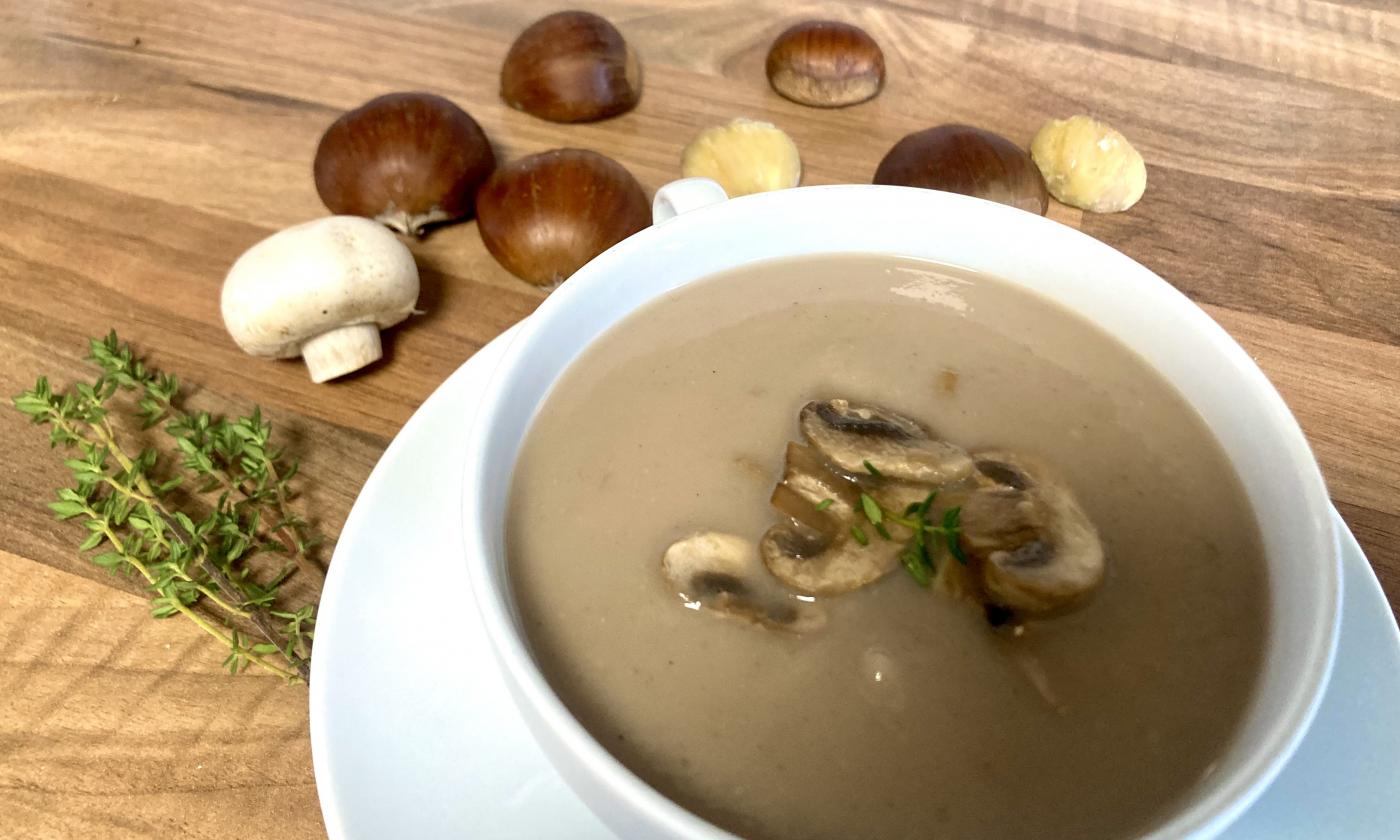
Italian chestnut soup with mushrooms and thyme
vegan


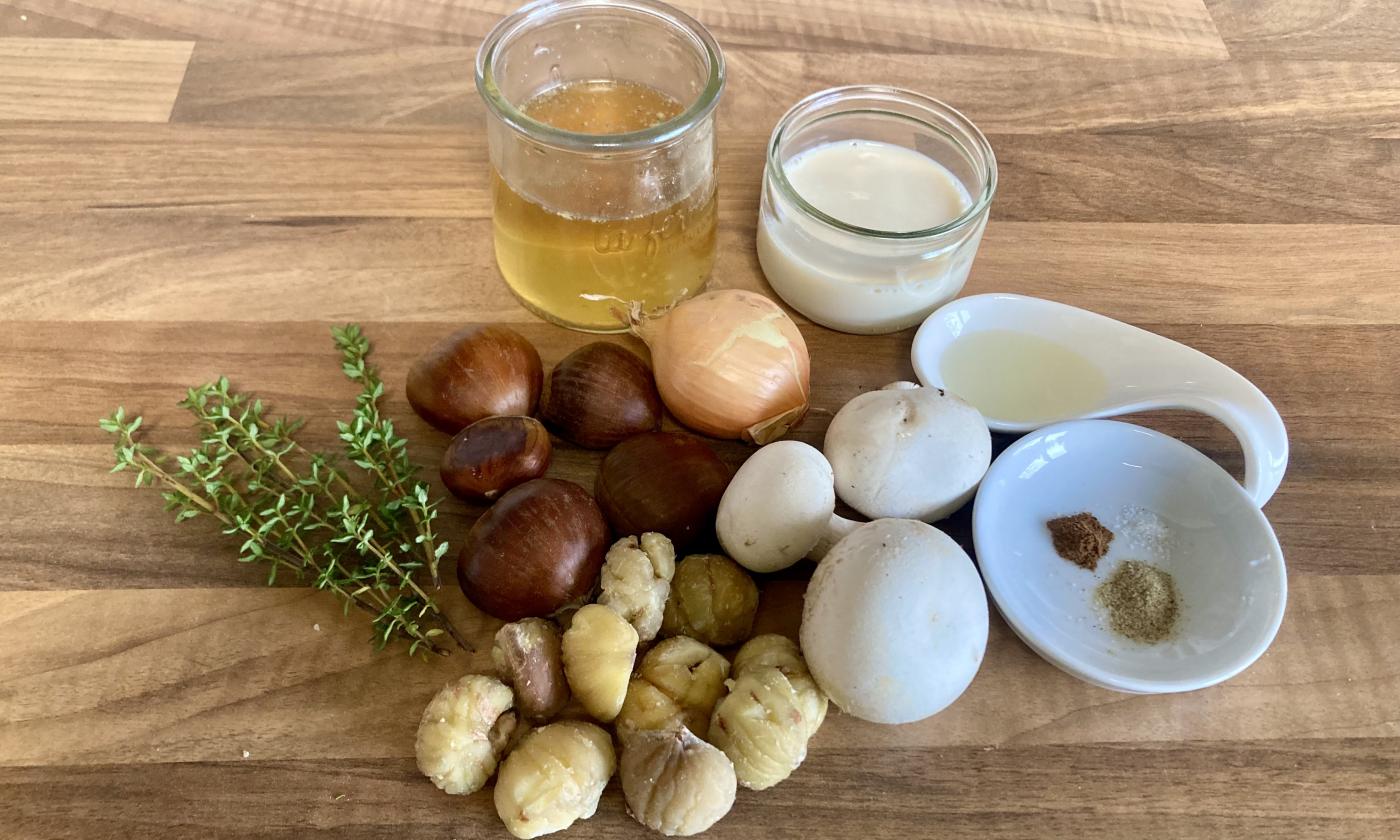
Ingredients (for servings, )
| For the soup | |
|---|---|
| 1 small | Onions, raw (organic) (1.6 oz) |
| ½ tbsp | Rapeseed oil, refined (organic) (0.25 oz) |
| 18 oz | Chestnuts, raw (marrons, marroni) |
| 500 ml | Vegan vegetable stock, organic (18 oz) |
| 2 sprigs | Thyme, raw (organic) (0.13 oz) |
| For the deposit | |
| ½ tbsp | Rapeseed oil, refined (organic) (0.25 oz) |
| 5 ½ oz | Cultivated mushrooms, raw (organic) |
| To complete | |
| 50 ml | Oat milk (oat drink, raw?, organic) (1.8 oz) |
| 1 dash | Table salt (table salt, raw?, organic) (0.01 oz) |
| 1 dash | White pepper (organic, raw?) (0.00 oz) |
| 1 dash | Cinnamon (ground, raw, organic) (0.00 oz) |
Equipment
- hand-held blender / immersion blender
- skillet (frying pan)
- stove
- saucepan
Type of preparation
- cook
- chop or grind
- sweat
- season to taste
- sauté
- purée
- remove the skin
Preparation
Preparing the soup
Peel and dice the onion. Heat the rapeseed oil in a pot and sauté the onion until translucent. Add the pre-cooked and peeled chestnuts and briefly sauté, stirring constantly. Deglaze with the vegetable stock (and white wine, if desired – see alternative preparation). Pluck a few thyme leaves for garnish, and add the rest as a whole sprig to the soup. Simmer the soup for about 10 minutes with the lid on.Important: Cooking chestnuts takes 25 minutes; cutting them open and peeling them afterwards takes between 30 and 60 minutes per 500g of chestnuts. You can buy pre-cooked chestnuts, but they are significantly less flavorful, which is why we recommend using fresh chestnuts.
Continue with the next steps while the cooking time is up.
For a quantity sufficient for 2 servings, we used 400g of pre-cooked and peeled chestnuts.For the mushrooms
Clean the mushrooms and slice them (halve larger mushrooms first). Heat rapeseed oil in a pan and sauté the mushrooms for about 2-3 minutes. Season with a little salt.Finishing the soup
Remove the thyme sprigs, add the oat milk to the soup, and purée the soup with an immersion blender (alternatively, you can pluck the leaves and purée them as well). Season the soup with salt, white pepper, and a pinch of cinnamon.
Add the fried mushrooms to the soup and serve with the thyme leaves as a topping.If you don't have oat milk, you can use some other plant milk or a little more stock instead.
Serving size: The specified quantity for 2 servings is sufficient for a main course for 2 or an appetizer for 4.
|
Nutritional Information per 100g
Convert per serving
|
2000 kcal | |
|---|---|---|
| Energy | 100 kcal | 5.0% |
| Fat/Lipids | 1.9 g | 2.8% |
| Saturated Fats | 0.21 g | 1.0% |
| Carbohydrates (inc.dietary fiber) | 20 g | 7.2% |
| Sugars | 0.96 g | 1.1% |
| Fiber | 2.9 g | 11.4% |
| Protein/Albumin | 1.2 g | 2.5% |
| Cooking Salt (Na:149.2 mg) | 60 mg | 2.5% |
| Essential micronutrients with the highest proportions | per 100g | 2000 kcal | |
|---|---|---|---|
| Vit | Vitamin C (ascorbic acid) | 18 mg | 23.0% |
| Min | Copper, Cu | 0.22 mg | 21.7% |
| Vit | Vitamin B9, B11 (Folate, as the active form of folic acid) | 30 µg | 14.9% |
| Elem | Potassium, K | 271 mg | 13.5% |
| Vit | Vitamin B6 (pyridoxine) | 0.18 mg | 12.7% |
| Vit | Vitamin K | 7.3 µg | 9.7% |
| Min | Manganese, Mn | 0.19 mg | 9.5% |
| Fat | Alpha-Linolenic acid; ALA; 18:3 omega-3 | 0.15 g | 7.3% |
| Vit | Vitamin B1 (Thiamine) | 0.08 mg | 7.1% |
| Vit | Vitamin B5 (Pantothenic acid) | 0.40 mg | 6.8% |
Detailed Nutritional Information per Person for this Recipe
The majority of the nutritional information comes from the USDA (US Department of Agriculture). This means that the information for natural products is often incomplete or only given within broader categories, whereas in most cases products made from these have more complete information displayed.
If we take flaxseed, for example, the important essential amino acid ALA (omega-3) is only included in an overarching category whereas for flaxseed oil ALA is listed specifically. In time, we will be able to change this, but it will require a lot of work. An “i” appears behind ingredients that have been adjusted and an explanation appears when you hover over this symbol.
For Erb Muesli, the original calculations resulted in 48 % of the daily requirement of ALA — but with the correction, we see that the muesli actually covers >100 % of the necessary recommendation for the omega-3 fatty acid ALA. Our goal is to eventually be able to compare the nutritional value of our recipes with those that are used in conventional western lifestyles.
| Essential fatty acids | per 100g | 2000 kcal |
|---|---|---|
| Alpha-Linolenic acid; ALA; 18:3 omega-3 | 0.15 g | 7.3% |
| Linoleic acid; LA; 18:2 omega-6 | 0.47 g | 4.7% |
| Essential amino acids | per 100g | 2000 kcal |
|---|---|---|
| Tryptophan (Trp, W) | 0.01 g | 5.5% |
| Threonine (Thr, T, irreversibly transaminated) | 0.04 g | 4.7% |
| Valin (Val, V) | 0.07 g | 4.4% |
| Isoleucine (Ile, I) | 0.04 g | 3.3% |
| Lysine (Lys, K, irreversibly transaminated) | 0.06 g | 3.2% |
| Phenylalanine (Phe, F) | 0.04 g | 2.8% |
| Leucine (Leu, L) | 0.06 g | 2.5% |
| Methionine (Met, M) | 0.02 g | 2.2% |
| Vitamins | per 100g | 2000 kcal |
|---|---|---|
| Vitamin C (ascorbic acid) | 18 mg | 23.0% |
| Vitamin B9, B11 (Folate, as the active form of folic acid) | 30 µg | 14.9% |
| Vitamin B6 (pyridoxine) | 0.18 mg | 12.7% |
| Vitamin K | 7.3 µg | 9.7% |
| Vitamin B1 (Thiamine) | 0.08 mg | 7.1% |
| Vitamin B5 (Pantothenic acid) | 0.40 mg | 6.8% |
| Vitamin B3 (Niacin) | 0.95 mg | 6.0% |
| Vitamin B7 (Biotin, ex vitamin H) | 2.3 µg | 4.6% |
| Vitamin B2 (Riboflavin) | 0.06 mg | 4.4% |
| Vitamin E, alpha-tocopherol (TE, E307) | 0.48 mg | 4.0% |
| Vitamin A, as RAE | 27 µg | 3.5% |
| Vitamin D | 0.02 µg | < 0.1% |
| Vitamin B12 (Cobalamin) | 0.00 µg | < 0.1% |
| Essential macroelements (macronutrients) | per 100g | 2000 kcal |
|---|---|---|
| Potassium, K | 271 mg | 13.5% |
| Phosphorus, P | 34 mg | 4.9% |
| Magnesium, Mg | 17 mg | 4.4% |
| Sodium, Na | 24 mg | 3.0% |
| Calcium, Ca | 17 mg | 2.1% |
| Essential trace elements (micronutrients) | per 100g | 2000 kcal |
|---|---|---|
| Copper, Cu | 0.22 mg | 21.7% |
| Manganese, Mn | 0.19 mg | 9.5% |
| Iron, Fe | 0.63 mg | 4.4% |
| Zinc, Zn | 0.31 mg | 3.2% |
| Selenium, Se (selenium, semimetal) | 1.2 µg | 2.2% |
| Iodine, I (Iodine, J) | 2.5 µg | 1.7% |
| Fluorine, F | 20 µg | < 0.1% |

Italian chestnut soup with mushrooms and thyme is an ideal soup for autumn and winter.
Time estimate: The preparation time does not include cooking and peeling the chestnuts, as this depends heavily on the portion size and the speed of the person preparing them. Cooking the chestnuts takes 25 minutes, while cutting them open and peeling them afterward takes between 30 and 60 minutes per 500g of chestnuts. We used fresh chestnuts and prepared them the day before. However, you can also buy pre-cooked chestnuts.
Serving size: The specified quantity for 2 servings is sufficient for a main course for 2 or an appetizer for 4.
Nutritional profile: According to GDA guidelines, one serving of this fiber-rich dish covers well over 100% of the average daily requirement for vitamin C and copper. Folic acid, potassium, and vitamin B6 are covered at approximately 80%. However, some heat-sensitive nutrients such as folic acid and vitamin C are lost during the cooking process, slightly reducing the amount per serving. The ratio of omega-6 to omega-3 fatty acids is 3:1, below the maximum recommended ratio of 5:1.
Further information on this topic can be found at the following link: Vegans often eat unhealthily. Avoidable nutritional mistakes.
Chestnuts: Compared to other nuts, chestnuts contain significantly less fat and calories. Due to their high starch and fiber content, the pleasantly sweet and nutty chestnuts are very filling. Furthermore, chestnut flour can be used as a grain substitute for people with gluten intolerance (celiac disease) because it is gluten-free.
Marrons vs. sweet chestnuts: Although the two terms are often used synonymously, strictly speaking, they do not refer to the same ingredient in German-speaking regions. Marrons are a cultivated variety of the sweet chestnut, thus distinguishing between common sweet chestnuts and true marrons. The latter have a flattened shape on one side and are generally larger than sweet chestnuts.
Vegetable stock: Instead of vegetable broth, we opted for the salt-free vegetable stock, which you can also make yourself in advance: Vegan vegetable stock.
If you lack the time or ingredients, you can also use ready-made vegetable broth or store-bought stock in the same quantity. However, for both, especially the former, the salt content of the recipe will increase considerably, which you should take into account when seasoning.
Refinement: You can add a splash of white wine to the chestnut soup while cooking.
You can also omit the oat milk entirely and add more stock or water instead.
Cooked chestnuts: You can buy pre-cooked chestnuts, however they are significantly less aromatic, which is why we recommend using fresh chestnuts.