

Linoleic acid; LA; 18:2 omega-6
Linoleic acid (LA) is an essential omega-6 fatty acid that is vital for healthy cell membranes and an intact skin barrier. Learn how the right ratio to omega-3 fatty acids regulates inflammation and impacts your health.
| We provide science-based information on health, nutrition, and sustainability — independent of sponsors, the food industry, and dietary supplement manufacturers. Find out more: our mission. |
A balanced, plant-based diet with few to no industrially processed foods generally provides sufficient macro- and micronutrients, with the exception of vitamin B12. However, phytochemicals are particularly relevant for maintaining health and healing, even though they are not considered essential nutrients – apart from vitamins.
---
Definition
Linoleic acid (LA) is a polyunsaturated essential fatty acid belonging to the omega-6 fatty acids. The human body can synthesize polyunsaturated fatty acids (PUFAs), except linoleic acid and alpha-linolenic acid (ALA), the precursor of omega-3 fatty acids. Because we must obtain these substances through our diet, we call them essential fatty acids (EFAs).
Occurrence
The most important sources of linoleic acid are seeds, kernels, and nuts such as walnuts (38 g/100 g), Brazil nuts (24 g), sunflower seeds (23 g), sesame seeds (21 g), almonds (12 g), flax seeds (6 g), and chia seeds (5.8 g). Grape seed oil (70 g), hemp oil (54 g), and sesame oil (41 g) have the highest linoleic acid content among plant oils. However, there are significantly healthier oils, such as flaxseed oil (14 g, rich in ALA) and rapeseed oil (19 g). Green herbs and vegetables, such as avocado (1.7 g) and dried parsley (1.2 g), also contain linoleic acid.1
Storage and Preparation Losses
Linoleic acid is sensitive to oxidation. Oils with a high linoleic acid content should be stored protected from light and oxygen, at cool temperatures, and consumed as quickly as possible. To optimally utilize the nutrients in oilseeds, one should use seeds that have already been processed or ground into grits. However, after grinding, the seeds are very sensitive to oxidation, which is why it is advisable not to store them further but to consume them immediately.
Nutrition - Health
From linoleic acid, the body produces gamma-linolenic acid (GLA) and, in further synthesis steps, the two omega-6 fatty acids dihomo-gamma-linolenic acid (DGLA) and arachidonic acid (AA). Consuming linoleic acid lowers total, LDL, and VLDL cholesterol, as well as serum triglycerides, and increases HDL cholesterol. It also improves insulin resistance and blood sugar levels.9 An ideal ratio of omega-6 to omega-3 fatty acids plays a crucial role in these health benefits. However, we generally consume too much LA relative to ALA. See the Erb Muesli recipe. It is designed to compensate for a daily imbalance of too many omega-6 to omega-3 fatty acids.
| Not only vegans or vegetarians should read this: Vegans often eat unhealthily. Avoidable nutritional mistakes. |
Long-term daily requirement
The daily requirement for linoleic acid is 5-8 g, which corresponds to approximately 2,5 % of daily energy intake. According to FAO and WHO, the proportion of linoleic acid should not exceed 9 % of daily energy intake.10 During pregnancy, lactation, and growth, the requirement for gamma-linolenic acid is particularly increased.
In the US, 85-90 % of dietary omega-6 fatty acids come from linoleic acid. The American Dietary Guidelines and the American Heart Association each recommend a linoleic acid intake of 5 to 10 % of total calories.9
Adequate intake of omega-6 fatty acids is associated with an omega-6 to omega-3 fatty acid ratio of no more than 5:1, in contrast to 10:1 or higher in a typical Western diet. Vegans and vegetarians sometimes have ratios as high as 24:1, which is considered unhealthy. An optimal ratio would be 2:1, as was common in Japan in the past; according to other sources, such as Dr. Greger, even a ratio of 1:1 is ideal.
Deficiency symptoms
often occur with extreme diets such as the 80/10/10 diet or in fruitarians. Low intake of linoleic acid and gamma-linolenic acid can lead to atopic dermatitis and premenstrual syndrome. Furthermore, a linoleic acid deficiency can contribute to increased allergies, impaired wound healing, anemia, frequent infections, and peripheral nervous system disorders such as neuropathies.
A deficiency in linoleic acid can also result from a defect in the enzyme delta-6-desaturase, which is responsible for the elongation of fatty acids. In diseases such as diabetes, multiple sclerosis, and atopic dermatitis, the function of this enzyme is often severely impaired. To maintain the activity of delta-6-desaturase, it is important to consume sufficient micronutrients, especially pyridoxine (vitamin B6), biotin, calcium, magnesium, and zinc.2,3,4
Overconsumption
Many people in industrialized countries consume more omega-6 fatty acids than their bodies need due to the excessive consumption of animal products, fast food and other typical foods.
When the concentration of linoleic acid (LA) in the blood rises sharply due to the consumption of large quantities, harmful substances can be formed, so-called oxidized LA metabolites (OXLAMs) such as 4-hydroxynonenal (HNE). Furthermore, the conversion of LA in the body can lead to the formation of free radicals such as heptanoic acid. In some cases, the body also converts LA into the pro-inflammatory arachidonic acid (AA). The increased levels of these oxidized metabolites and free radicals in the blood lead to various diseases such as cardiovascular disease, arteriosclerosis, and liver disease.
Functions in the body
Linoleic acid is important for the formation and maintenance of cell membranes.11
The body synthesizes dihomo-gamma-linolenic acid (DGLA) from linoleic acid via the intermediate gamma-linolenic acid (GLA).
DGLA serves as a precursor for the production of anti-inflammatory eicosanoids. At the same time, DGLA is also a precursor of arachidonic acid (AA), which forms pro-inflammatory eicosanoids. Eicosanoids are tissue hormones that, depending on their type, can both promote and inhibit inflammation.
Linoleic acid, alpha-linolenic acid, and oleic acid compete for the same enzyme system, delta-6-desaturase. The higher the supply of linoleic acid, the greater the affinity for the enzyme and the more GLA can be synthesized. However, if the proportion of linoleic acid is significantly higher than that of alpha-linolenic acid, this can lead to increased production of the pro-inflammatory arachidonic acid. Therefore, a balanced ratio of linoleic acid to alpha-linolenic acid in the diet is important.
Linoleic acid is an important component of human skin, particularly the epidermis. The epidermal barrier, which regulates water balance, consists of ceramides, free fatty acids, and phospholipids. Ceramides play a crucial role in water regulation, and the most important ceramide is ceramide 1, whose main component is linoleic acid.
Gamma-linolenic acid, found in borage, evening primrose, and hemp seed oil, can have a positive effect on inflammatory processes in the body. Furthermore, gamma-linolenic acid supports nerve impulse transmission in the brain and lowers blood pressure.2,3,4
Absorption and Metabolism
Linoleic acid (LA) undergoes mechanical and enzymatic breakdown in the gastrointestinal tract (mouth, stomach, and small intestine) as part of fat digestion. The broken-down fatty acids are transported via micelles into the intestinal cells and from there, bound as lipoproteins, via the blood and lymph to the liver and other target cells such as the brain, heart, and skin.2,3,4 Within the cells, the body incorporates linoleic acid into cell membrane lipids or uses it as a substrate for metabolic reactions.11
Storage - Consumption - Losses
Approximately 30 % of linoleic acid is found in blood plasma. Smaller amounts of LA are also found in platelet and erythrocyte membranes (9,3 % and 9,7 %, respectively). In plasma, the body predominantly esterifies LA into cholesterol esters (approximately 50 %), followed by phospholipids (40 %) and triglycerides (10 %). In cell membranes, the body incorporates LA at the sn-2 position into phospholipids, triglycerides, and cholesterol esters.11
The acyl-CoA-binding protein serves, among other things, as an intracellular pool and transporter of activated long-chain fatty acids and enables the resynthesis of triglycerides and phospholipids in the smooth endoplasmic reticulum. Fatty acid degradation occurs in all body cells and takes place in the mitochondria via β-oxidation.
Blood fatty acid levels vary with age. In fact, linoleic acid concentrations in the blood are lower in newborns, comprising about 4,6 % of total fatty acids. During childhood and adulthood, concentrations rise to 17,7 % and 18,4 %, respectively, and then remain constant. Furthermore, plasma linoleic acid levels are generally higher in women than in men.11
Structure
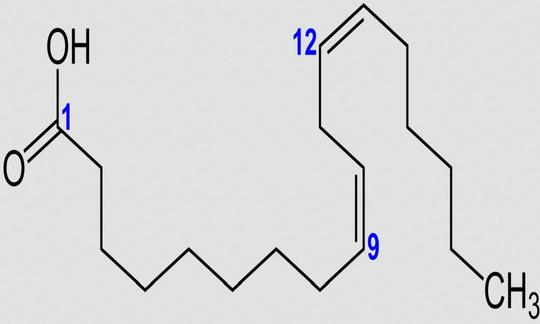
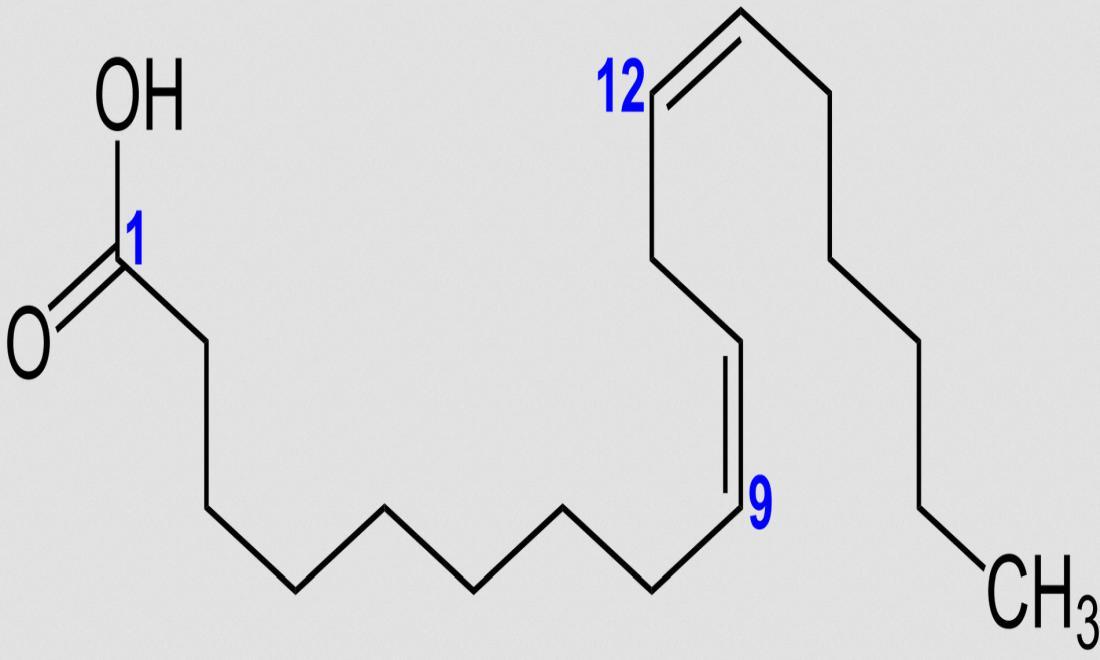
Linoleic acid (LA) is a polyunsaturated fatty acid with 18 carbon atoms (18:2). It belongs to the omega-6 fatty acid group due to the position of its second double bond. Linoleic acid appears as a colorless to straw-colored liquid. Its IUPAC name is (9Z,12Z)-octadeca-9,12-dienoic acid, and its molecular formula is C18H32O2. Other names for linoleic acid are (cis, cis)-octadeca-9,12-dienoic acid and lipid name 18:2 (ω−6). It was formerly also known as linseed oleic acid or telfairic acid.12
Bibliography - 12 Sources (Link to the evidence)
| 1. | US-Amerikanische Nährwertdatenbank USDA. |
| 2. | Biesalski HK, Grimm P. Taschenatlas der Ernährung. 6. Auflage. Georg Thieme Verlag: Stuttgart und New York. 2015. |
| 3. | Zimmermann M, Schurgast H et al. Burgersteins Handbuch Nährstoffe. 9. Auflage. Karl F. Haug Verlag: Heidelberg. 2000. |
| 4. | Pietrzik K, Golly I et al. Handbuch Vitamine. Für Prophylaxe, Beratung und Therapie. Urban & Fischer Verlag: München. 2008. |
| 5. | Letzmann C, Keller M. Vegetarische Ernährung. 3. Auflage. Eugen Ulmer Verlag: Stuttgart. 2013. |
| 6. | Greger M. How Not to Die: Discover the Foods Scientifically Proven to Prevent and Reverse Disease. Macmillan: New York. 2015. |
| 7. | Bertoni C, Abodi M et al. Alpha-Linolenic Acid and Cardiovascular Events: A Narrative Review. Int J Mol Sci. 2023 Sep 20;24(18):14319. |
| 8. | Mercola J, D'Adamo CR. Linoleic Acid: A Narrative Review of the Effects of Increased Intake in the Standard American Diet and Associations with Chronic Disease. Nutrients. 2023 Jul 13;15(14):3129. |
| 9. | Mousavi SM, Jalilpiran Y et al. Dietary Intake of Linoleic Acid, Its Concentrations, and the Risk of Type 2 Diabetes: A Systematic Review and Dose-Response Meta-analysis of Prospective Cohort Studies. Diabetes Care. 2021 Sep;44(9):2173-2181. |
| 10. | BLV Bundesamt für Lebensmittelsicherheit und Veterinärwesen. Fette in der Ernährung. Aktualisierte Empfehlungen der Eidgenössischen Ernährungskommission. Supplementum zum Expertenbericht „Fette in der Ernährung“ mit den aktualisierten Empfehlungen. 2013. |
| 11. | Marangoni F, Agostoni C et al. Dietary linoleic acid and human health: Focus on cardiovascular and cardiometabolic effects. Atherosclerosis. 2020 Jan;292:90-98. |
| 12. | PubChem. Linoleic acid. [zitiert 20. August 2024]. |
- Michael Weber, Federal diploma Pharmacist, MSc Infection Biology (Lead Author)
- Karin Rustmeier, Dipl. Food Engineer ETH (Author)
- Ernst Erb (Validator)
- Ranin Huemer, BSc in Nutritional Science (Validator)
Stuffed Eggplant with Nut and Pomegranate Filling is a delicious and hearty Iranian dish.

Our date and walnut balls with carob powder are naturally sweet, very quick to prepare, and a nice healthy snack.
This Walnut Tortellini with a Red Wine Mushroom Reduction takes some time and practice, but the result is well worth it.

Grape seed oil is pressed from the seeds of grapes, but it contains far too much linoleic acid to be healthy.

Cold-pressed sunflower oil (raw? organic?) contains polyunsaturated fatty acids. Unfortunately, mainly a shocking amount of linoleic acid (LA), which promotes i

Truffle oil is used in the kitchen to give salads and dishes the truffle aroma. No pressing process is used in the production process. Raw? Organic?
Comments