This page was translated through Google Translator
Vitamin K
Vitamin K plays a vital role in blood clotting and bone metabolism. It is found in green vegetables, fermented foods, and even in your gut flora. Find out what risks a deficiency entails and how you can ensure you meet your needs.
We provide science-based information on health, nutrition, and sustainability — independent of sponsors, the food industry, and dietary supplement manufacturers. Find out more: our mission.
A balanced, plant-based diet with few to no industrially processed foods generally provides sufficient macro- and micronutrients, with the exception of vitamin B12. However,phytochemicalsare particularly relevant for maintaining health and healing, even though they are not considered essential nutrients – apart from vitamins.
---
Definition
Vitamin K was discovered accidentally in 1929 during experiments on sterol metabolism and was immediately linked to blood coagulation. In the following ten years, the most important K vitamins, phylloquinone (vitamin K1) and menaquinone (vitamin K2), were isolated and characterized.
Occurrence
Vitamin K1 is a naturally occurring substance found mainly in photosynthetically active organisms such as algae, cyanobacteria, and green plants. Rich sources include green leafy vegetables and herbs, e.g., Swiss chard (830 µg/100g), kale (705), garden cress (542), spinach (483), fresh basil (415), chicory (298), spring onion (207), Brussels sprouts (177), broccoli (102), and leeks (47). The vitamin K1 content of plants depends on variety, cultivation method, location, climatic factors, and ripeness.
Vitamin K2 enters the body through food, especially fermented foods such as sauerkraut (5.5 µg/100g) 17 and, in Japan, natto (approx. 900 µg/100g), as well as dairy products, particularly cheese. In the gut, obligate and facultative anaerobic bacteria also contribute to the production of vitamin K2. 11,14,15 Fermented beverages such as beer or wine contain practically no vitamin K2, since yeasts, unlike bacteria, do not produce menaquinone. 15
In addition to its natural forms, vitamin K also exists in synthetic and supplemental forms. K1 and K2 can be chemically produced and used as dietary supplements or medications. Vitamin K3 (menadione) is a synthetic, water-soluble form without a side chain. Unlike K1 and K2 supplements, K3 can be toxic in high doses, for example, with a risk of hemolytic anemia in infants. K3 is not obtained from food but serves as a metabolic intermediate and plays a negligible role in nutrition. Vitamin K4 also exists as a synthetic form and can be a reduced variant of K3 (menadiol) or an ester thereof (e.g. diacetate).
The biological activity of vitamin K is due to its ability to switch between its oxidized (quinone) and reduced (hydroquinone) forms in the vitamin K cycle.
Storage and Preparation Losses
Due to the heat stability of the vitamin K group, only minor vitamin losses occur during preparation, especially cooking. Vitamin K is also stable against oxygen. Light, however, inactivates the vitamin.
Nutrition - Health
Vitamin K is one of the fat-soluble vitamins. The "K" originally stood for coagulation, as the vitamin plays an essential role in the blood clotting system. Besides the naturally occurring vitamins K1 and K2, there are other quinones with vitamin K activity. Furthermore, vitamin K2 is involved in bone metabolism and in maintaining cardiovascular and kidney health. 3,12,16
Recommended intakes for vitamin K are largely based on estimates and are 65-80 µg/day for adults. With a balanced diet and healthy gut flora, the daily requirement is generally considered to be met. The extent to which vitamin K2 produced by gut bacteria contributes to meeting the requirement is not yet fully understood.
Deficiency symptoms
Vitamin K deficiency symptoms manifests as spontaneous skin bleeding (purpura), nosebleeds, bleeding in the gastrointestinal or urogenital tract, and bleeding gums. A deficiency is rare in adults but can be caused by various factors: a diet low in vitamin K, liver disease, cholestasis (bile stasis), cystic fibrosis, alcoholism, and malabsorption syndromes (e.g., in chronic inflammatory bowel diseases).15
Newborns are particularly vulnerable: While the mother's colostrum contains vitamin K, subsequent normal breast milk provides only small amounts. Furthermore, vitamin K barely reaches the fetus via the placenta. Adding to these factors, newborns often have physiological (normal) fatty stools. Therefore, there is a possibility of vitamin K deficiency in infants. In most countries, newborns, both full-term and premature, routinely receive vitamin K prophylaxis immediately after birth to prevent hemorrhagic diseases. 3,5,11
Vitamin K1 deficiency in infants can lead to serious complications such as brain hemorrhages. 3,13
Coumarin derivatives, so-called anticoagulants (blood thinners), are antagonists of vitamin K. In case of overdose, they can lead to life-threatening bleeding due to a relative vitamin K deficiency. 3,5
It is also known that broad-spectrum antibiotics can inhibit the growth of some vitamin K-producing bacteria and thus increase the risk of vitamin K deficiency. 15
Oversupply
Toxic properties of vitamin K (K1 and K2) from food are not known. Vitamin K3, however, can be dose-dependently toxic, especially in newborns, and lead to hemolytic anemia. This is related to its chemical structure and redox activity, which are not present in K1 and K2. 15
However, relatively small amounts of vitamin K (1 mg) can counteract the effects of anticoagulant drugs of the coumarin group, such as phenprocoumon or warfarin; if these drugs are being used, no additional vitamin K should be consumed beyond the normal diet. 3
Functions in the body
The essential role of vitamin K lies in its contribution to the introduction of a carboxyl group into the γ-position of glutamyl residues in certain proteins. Vitamin K acts as a cofactor for γ-glutamyl carboxylase. To date, fourteen proteins are known for whose synthesis vitamin K is necessary. Of these, six proteins are involved in the blood coagulation system. 2,3,5
Regulation of blood coagulation: Vitamin K supports the conversion of coagulation factors II, VII, IX, and X into their active forms. The liver also synthesizes the precursors of the anticoagulant proteins C and S and activates them with the help of vitamin K.
Bone metabolism: Vitamin K2 activates osteocalcin, which can then bind calcium and incorporate it into the bones.
Vitamin K2 plays an essential role as an electron transporter in the mitochondria. 6,7 It also supports the prevention of liver cirrhosis and reduces the risk of Alzheimer's disease. 16
Cancer research: For some time now, various studies have suggested that vitamin K2 appears to have a lasting effect on a number of cancers. 6,7
Absorption and Metabolism
Vitamin K1 (Phylloquinone): Vitamin K1 is absorbed via the formation of micelles with bile salts, uptake into intestinal cells, and transport via chylomicrons into the lymphatic system. 15 The absorption rate ranges from 20% to 70% and depends, among other things, on the pH value as well as the type and chain length of the fatty acids. 3,5 Dietary fat increases bioavailability approximately threefold, as it stimulates bile production and supports micelle formation. After absorption, K1 is primarily transported to the liver, which uses it for blood clotting and other functions. Serum levels of K1 remain low, with a half-life of approximately 1–2 hours, even with long-term intake. 15
Vitamin K2 (menaquinone, MKs): The absorption of vitamin K2 is generally good, especially of the long-chain forms (e.g., MK-7). After absorption, chylomicrons and lipoproteins transport K2 to other tissues outside the liver. Long-chain MKs have a long half-life (e.g., MK-7 about 3 days, MK-9 about 60 hours), while MK-4, similar to K1, disappears rapidly from the blood, with the concentration reaching almost zero after 24 hours.
Some of the vitamin K2 produced by bacteria enters the bloodstream. Broad-spectrum antibiotics can inhibit the growth of these K2 -producing bacteria, thus increasing the risk of vitamin K deficiency. K2 forms with long side chains are poorly absorbed in the distal large intestine; however, absorption occurs in the terminal ileum (the last part of the small intestine), where intestinal bacteria are still present. Bile salts support absorption by dissolving the side chains that are tightly bound to the inner membranes of the bacteria. 15
Storage - Consumption - Losses
Although vitamin K is a fat-soluble vitamin, the body stores only small amounts, and without regular food intake, these reserves are quickly depleted. Human cells cannot synthesize vitamin K2 themselves and must obtain it through food, although the amount of vitamin K2 in normal foods is relatively low. 17
Studies of European populations have shown that with a Western diet, 90 % of ingested vitamin K is in the form of vitamin K1 and only 10% in the form of vitamin K2. The only people who ingest large amounts are the Japanese, who consume natto—a food made from fermented soybeans with Bacillus subtilis natto, which alone contains about 800–900 µg of highly bioavailable vitamin K2 per 100 g. 17 In Europe, plasma levels of MK-7 are below 1 nM or in the low nM range, whereas in a recent Japanese study, mean MK-7 levels were 15.6 nM. 15
Vitamin K1 and K2 follow similar metabolic pathways: The first step is ω-hydroxylation by CYP4F2, followed by shortening of the polyisoprene side chain via β-oxidation to carboxylic acids. These metabolites are excreted from the body in glucuronidated form via urine and bile. The excretion of these metabolites serves as a marker for the body's vitamin K status. 15
Vitamin K3 is present in the liver only in small amounts, spreads more rapidly throughout the body compared to the natural forms phylloquinone and menaquinone, and is metabolized more quickly. 5
Interesting Facts
The discovery of vitamin K is primarily attributed to the Danish scientist Henrik Dam in 1929. In his experiments with chicks, he observed that certain foods led to internal bleeding, similar to scurvy. High doses of vitamin C, however, could not cure this. Henrik Dam found that grains and seeds could prevent this bleeding, but not cod liver oil (rich in vitamins A and D). He concluded that another, previously unknown, fat-soluble nutrient was missing, which he named the "coagulation vitamin" or vitamin K in 1935.
Further studies showed that this vitamin is found in various animal and plant tissues, especially in pork liver fat. Good sources of vitamin K include green leaves such as alfalfa and bacterially decomposed bran or fishmeal. 9
Structures
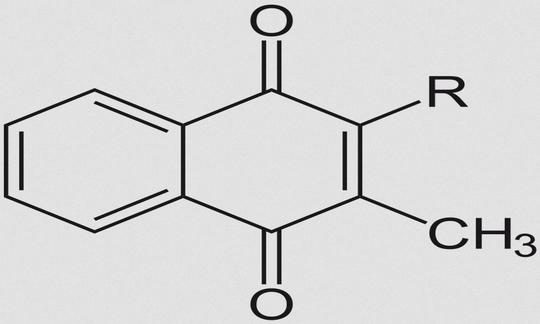
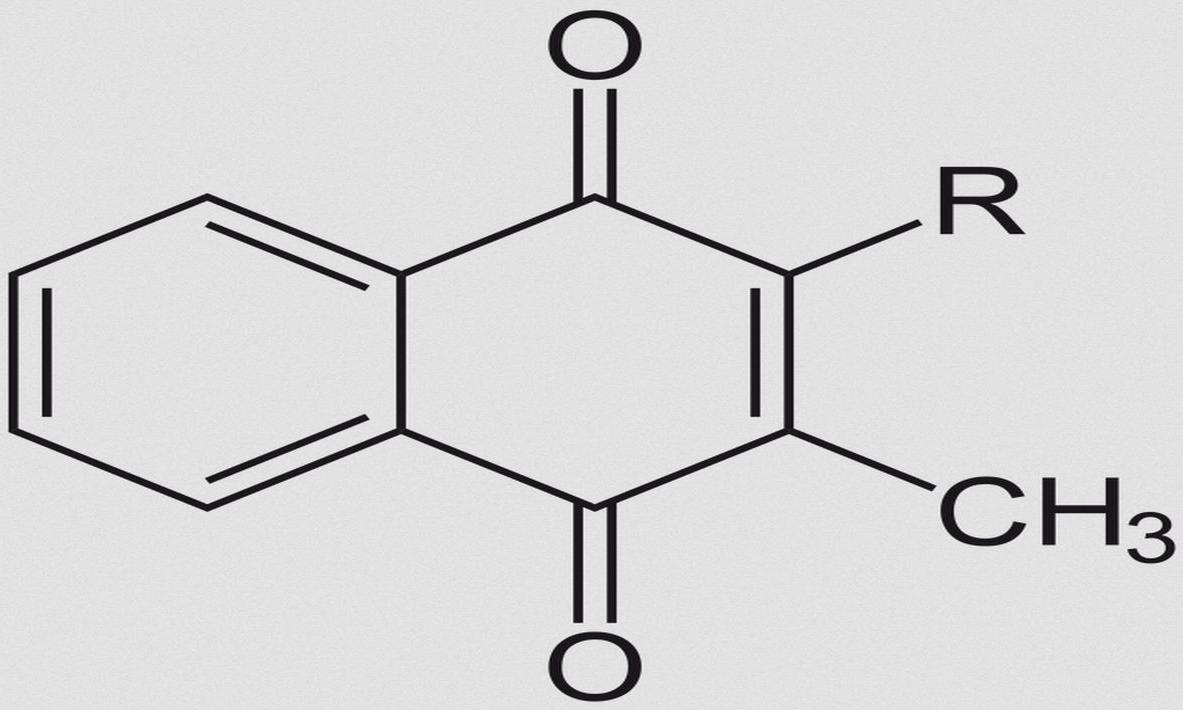
It occurs in two biologically active forms: phylloquinone (vitamin K1) and menaquinone (vitamin K2), as well as in synthetic forms such as menadione (vitamin K3) and esterified menadione (vitamin K4). All vitamin forms possess the same 2-methyl-1,4-naphthoquinone ring (menadione), but differ in the substitution at the third carbon atom of the naphthoquinone ring. 17 Phylloquinone contains a phytyl side chain consisting of four isoprenoid units, one of which is unsaturated. Menaquinones form a group of compounds with unsaturated isoprenoid side chains of varying lengths—from four to 13 units (MK-4 to MK-13). 14
These structural differences affect their properties: The methyl group is responsible for the vitamin's activity, while the side chains determine fat solubility. 3






Comments