

Vitamin B12 (Cobalamin)
Vitamin B12 is crucial for maintaining good health, which is why we have a store of it that lasts for several years. Read on to learn how to get enough through a natural diet – even as a vegan.
| We provide science-based information on health, nutrition, and sustainability — independent of sponsors, the food industry, and dietary supplement manufacturers. Find out more: our mission. |
A balanced, plant-based diet with few to no industrially processed foods generally provides sufficient macro- and micronutrients, with the exception of vitamin B12. However, phytochemicals are particularly relevant for maintaining health and healing, even though they are not considered essential nutrients – apart from vitamins.
---
Definition
Vitamin B12 (cobalamin) is a water-soluble B vitamin and a collective term for a number of vitamin-active cobalamins that contain the element cobalt. Cobalamin was the most recently discovered vitamin, found in 1948, but its structure was not elucidated until 1955. It is found in animal-based foods such as meat, milk, and fish.1,9
Occurrence
Plants are unable to produce vitamin B12 themselves. Vitamin B12 can only be produced by microorganisms (bacteria) that live as symbionts in the digestive tracts of animals and humans, as well as on the surface of plant hosts (e.g., legumes). Bacteria that produce vitamin B12 are found in the human large intestine. However, this vitamin is not usable because humans can only absorb it in the lower part of the small intestine.
Vegetables preserved through lactic acid fermentation, some types of algae, as well as legumes such as peas, beans, and lupins, and Zingiberales such as ginger contain a vitamin B12 content, albeit a very small one.6 No plant-based food contains sufficient amounts of the usable form of the vitamin to meet human needs. With algae, it is unclear whether they contain analogues instead, as the difference is minimal. Analogues occupy the receptors for vitamin B12, which makes it difficult for our bodies to absorb actual vitamin B12. Numerous products on the market massively mislead consumers. According to a seemingly well-researched source, Chlorella could be the only possible direct vegan source for us, but even then, the necessary quantity is the problem. Chlorella species form spherical, solitary cells with a diameter of 2 to 10 µm.8,15
Storage and preparation losses
Vitamin B12 is water-soluble and sensitive to light and oxygen. Average preparation losses of foods containing vitamin B12 are approximately 12 %.
Nutrition - Health
Vitamin B12 is important for the development and function of the central nervous system, as well as for the formation of healthy red blood cells and DNA synthesis. It works closely with two enzymes, methionine synthase and L-methylmalonyl-CoA mutase.12,14
| This is not just for vegans or vegetarians: Vegans often eat unhealthily. Avoidable nutritional mistakes. |
Long-term daily requirement
The minimum daily requirement, which is much lower compared to most other vitamins, is approximately 3 µg for an adult, taking into account a 50 % absorption loss.1 For the first six months of life, the vitamin B12 requirement is estimated at 0,4 µg per day. For children between 1 and 3 years of age, 0,9 µg/day is recommended. Between 14 and 18 years of age, the recommendation is 2,4 µg/day.12 Pregnant and breastfeeding women are assumed to have an increased requirement of 3,5–4,0 µg.1
Deficiency symptoms
According to the National Nutrition Survey (NVS II, 2008), a total of 8 % of men and 26 % of women do not reach the recommended daily intake of vitamin B12.10 Often, undetected deficiencies in vitamin B12 or cobalamins are clearly due to dietary errors. 52 % of vegans with less than 118 pmol/l show a vitamin B12 deficiency.16
Vitamin B12 deficiency leads to a specific form of anemia, pernicious anemia, in which the red blood cells are enlarged, and to subacute combined degeneration of the spinal cord, damage to the central nervous system. In recent years , evidence has also increased suggesting a possible link between vitamin B12 deficiency and other conditions, such as dementia and neuropathies. High folate intake could mask a vitamin B12 deficiency, allowing neurological damage to progress. High folic acid levels could also exacerbate or accelerate neurological problems associated with vitamin B12 deficiency.
Early signs of vitamin B12 deficiency can include tingling and a feeling of coldness in the hands and feet, fatigue, and weakness. A vitamin B12 deficiency also leads to elevated blood levels of homocysteine, which is a risk factor for the development of atherosclerosis (a group of diseases known as arteriosclerosis) and cardiovascular disease.
An elevated homocysteine level can indicate several things: vitamin B12 and B6 deficiency and/or folic acid deficiency. Vegans consume plenty of vitamin B6 and folate. Since both vitamins break down homocysteine, homocysteine levels can appear normal despite a vitamin B12 deficiency. Measuring total vitamin B12 in the blood is also not a reliable indicator. Because it includes biologically inactive forms of B12, a functional deficiency cannot be ruled out. If a deficiency is suspected, the concentration of methylmalonic acid (MMA) in the urine can be tested. The creatinine level in the urine compensates for dilution effects. Additionally, holo-transcobalamin in the serum is measured. Only if the cause is not dietary are the Schilling test or DUST used to investigate the underlying cause.
A deficiency is due to insufficient dietary intake or inadequate absorption. When absorption in the gastrointestinal tract is impaired, the body lacks intrinsic factor, which is essential for vitamin B12 absorption. Vitamin B12 deficiency also typically occurs in cases of severe ileal inflammation, particularly in Crohn's disease, autoimmune gastritis, and other intestinal diseases with malabsorption syndromes.1,2,3,4
In these cases, regular vitamin B12 supplementation is necessary, but this should be administered bypassing the gastrointestinal tract via intramuscular, subcutaneous, or, rarely, intravenous injection. Supplementation via regular tablet intake or sprays is also possible.
Oversupply
The blanket statement that water-soluble vitamins (e.g., all B vitamins) can be consumed in large quantities via supplements without undesirable side effects is still common.5 However, a consistently excessive intake of vitamin B12 via supplements or injections increases the risk of lung cancer.7,12 This is why we do not share the view that one should inject 1 ml four times a year, but only twice a year. Preferably with methylcobalamin instead of cyanocobalamin, because methylcobalamin remains in the bloodstream for a significantly longer time without being excreted by the body.
What to do if vitamin B12 blood levels are too high? After taking a higher dose of vitamin B12, a blood test should only be performed 10 days later. If the test method is correct, this could indicate either a malabsorption problem or a serious illness. To rule this out, an MMA urine test should be performed. This test shows how much B12 the cells actually receive. The test can be done at home and costs approximately €40 (2019). Possible causes include binding disorders to the transport molecule, antibody formation to transcobalamin II, or excessive production of haptocorrins.
Functions in the body
Cobalamin is involved in three metabolic reactions:1,2,3,4,15
- Methionine synthase is responsible, among other things, for the synthesis of methionine from the breakdown product homocysteine. This breakdown is also folic acid-dependent.
The breakdown of homocysteine also leads to tetrahydrofolic acid (THF). THF regulates protein and nucleic acid metabolism, DNA synthesis, and the synthesis and breakdown of various amino acids. - Methylmalonyl-CoA mutase is essential for the breakdown of propionic acid in the mitochondria. Propionic acid is produced during the breakdown of fatty acids and amino acids and enters the citric acid cycle via this reaction.
- The leucine mutase requires cobalamin as a cofactor for the breakdown of the amino acid leucine.
Absorption and Metabolism
Vitamin B12 is present in food in free form or bound to proteins. In the stomach, gastric acid and digestive enzymes release cobalamin bound to proteins. The free cobalamin binds to glycoproteins called haptocorrins, which are secreted by the salivary glands and gastric mucosal cells. The cobalamin-haptocorrin complex enters the upper part of the small intestine. There, under the influence of digestive enzymes and an alkaline pH, the complex is cleaved, and vitamin B12 binds to intrinsic factor (IF), a protein produced by the parietal cells of the gastric mucosa. The cells of the lower part of the small intestine absorb this vitamin B12-protein complex.
The absorption capacity of the cobalamin-IF complex by the small intestinal mucosa is limited. Approximately 1 % of dietary cobalamin enters the bloodstream without prior binding to IF via a non-specific mechanism through the gastrointestinal tract or oral mucosa. With high oral intake, this passive cobalamin absorption becomes increasingly important.1,2,3,4
Storage - Consumption - Losses
Vitamin B12 is the only water-soluble vitamin that the body stores in significant amounts. This is in the form of hydroxocobalamin ("hydroxocobalam..."). The main storage organs are the liver (60 %) and skeletal muscle (30 %). The total body content is 2-5 mg.1 The relatively high body stores and the low turnover rate of vitamin B12 (2 µg/day) are the reasons why a vitamin B12 deficiency often only becomes clinically apparent after years.
The estimated bioavailability of vitamin B12 from food varies depending on the dose, as absorption decreases drastically when the capacity of the intrinsic factor (at 1–2 µg of vitamin B12) is exceeded. The type of food source also affects bioavailability. Dairy products offer approximately three times the bioavailability of vitamin B12 compared to meat, fish, and poultry. The bioavailability of this vitamin from supplements is about 50 % higher than that from food sources.12
Structures
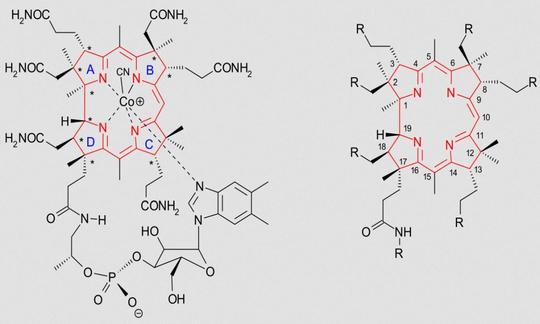
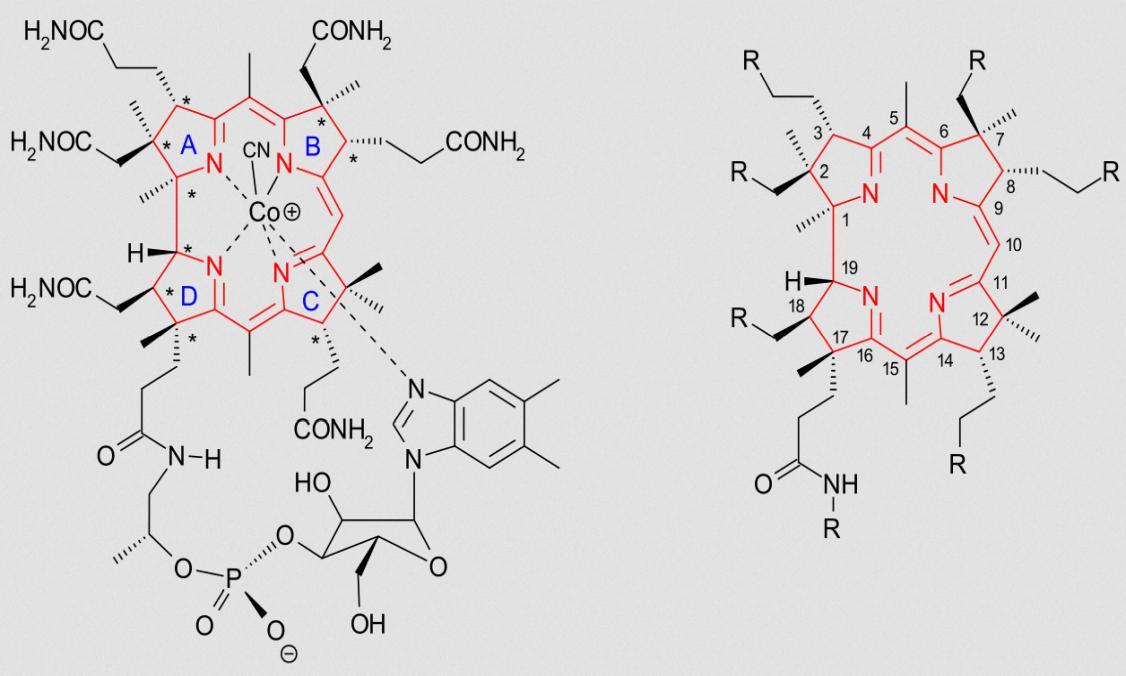
Cobalamin consists of a corrin ring system made up of pyrrole rings with cobalt as the central atom, to which a variable ligand is bound. Cyanocobalamin is the synthetic form found in most vitamin B12 supplements. Adenosylcobalamin and methylcobalamin are the active forms of vitamin B12.1
Bibliography - 16 Sources (Link to the evidence)
| 1. | Biesalski HK, Grimm P. Taschenatlas der Ernährung. 6. Auflage. Georg Thieme Verlag: Stuttgart und New York. 2015. |
| 2. | Elmadfa I, Leitzmann C. Ernährung des Menschen. 5. Auflage. Verlag Eugen Ulmer: Stuttgart. 2015. |
| 3. | Elmadfa I, Meyer A. Ernährungslehre. 3. Auflage. Verlag Eugen Ulmer: Stuttgart. 2015. |
| 4. | De Groot H, Farhadi J. Ernährungswissenschaft. 6. Auflage. Verlag Europa-Lehrmittel: Haan-Gruiten. 2015. |
| 5. | Domke A, Grossklaus R et al. (Hrsg.) Verwendung von Mineralstoffen in Lebensmitteln: Toxikologische und ernährungsphysiologische Aspekte, Teil 1. BfR-Hausdruckerei Dahlem. 2004. |
| 6. | Busch-Stockfisch M. Lebensmittel-Lexikon. 4. Auflage. Behr’s Verlag DE. 2005. |
| 7. | Deutsche Apotheker Zeitung. Drei Fragen zu Vitamin B12. 2022. |
| 8. | Vitaminb12 de. Vitamin B12 und Gesundheit. |
| 9. | Watanabe F, Bito T. Determination of Cobalamin and Related Compounds in Foods. J AOAC Int. 2018 Sep 1;101(5):1308-1313. |
| 10. | Bundesamt für Ernährung, Landwirtschaft und Verbraucherschutz. Max Rubner-Institut. Nationale Verzehrsstudie II. Ereignisbericht Teil 2. 2008. |
| 11. | Güitrón Leal CE, Palma Molina XE et al. Vitamin B12 supplementation for growth, development, and cognition in children. Cochrane Database Syst Rev. 2022 Nov 11;2022(11):CD015264. |
| 12. | Institute of Medicine, Food and Nutrition Board. Dietary Reference Intakes for Thiamin, Riboflavin, Niacin, Vitamin B(6), Folate, Vitamin B(12), Pantothenic Acid, Biotin, and Choline. Washington, DC: National Academies Press; 1998. |
| 13. | Tucker KL, Rich S et al. Plasma vitamin B-12 concentrations relate to intake source in the Framingham Offspring study. Am J Clin Nutr. 2000 Feb;71(2):514-522. |
| 14. | Allen LH. Vitamin B-12. Adv Nutr. 2012 Jan; 3(1):54-55 |
| 15. | O'Leary F, Samman S. Vitamin B12 in health and disease. Nutrients. 2010 Mar;2(3):299-316. |
| 16. | Gilsing AMJ, Crowe FL, Lloyd-Wright Z, Sanders TAB, Appleby PN, Allen NE et al. Serum concentrations of vitamin B12 and folate in British male omnivores, vegetarians and vegans: results from a cross-sectional analysis of the EPIC-Oxford cohort study. Eur J Clin Nutr. 2010 Sep;64(9):933-939. |
- Karin Rustmeier, Dipl. Food Engineer ETH (Lead Author)
- Ernst Erb (Author)
- Katharina Hofer, MSc Organic Agriculture (Validator)
- Ranin Huemer, BSc in Nutritional Science (Validator)
Curry orange tempeh with spiced rice is a hearty, filling dish reminiscent of Indian cuisine. It goes very well with chutney.

The mixed mushroom pan with fresh green pepper and whole wheat spaghetti is wonderfully creamy - and it doesn't require any cream.

This mushroom burger with lupine flour and grits is a protein powerhouse and amazingly low in fat. Please note that the recipe is only for the patties.

Miso (soybean paste) tastes like fermented beans and can range from spicy to sweet. Miso is a natural flavor enhancer.

Tempeh (Tempe) is a fermentation product originally from Indonesia. It is made from cooked soybeans and is therefore never raw. Organic?

The cultivated mushroom can also be eaten raw. Champignons are very popular edible mushrooms and are available in white and brown. Organic?
Comments