101 Reasons to Go Vegan
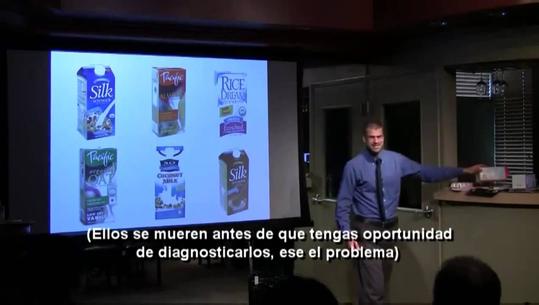
"101 Reasons to Go Vegan" – an entertaining presentation made by James Wildman, a humanitarian educator within The Florida Animal Rights Foundation. It focuses mainly on how people are tricked into believing false affirmations like “milk does your body good” and “you have to eat meat to get your proteins” and tries to show why people are in fact omnivores and not carnivores. In a logical and structured sequence, James Wildman proves not only that killing other animals for food is cruel and unnecessary, but also that it is detrimental to our health.
00:04.40: If you are told a lie enough times, it becomes part of your reality. If enough people are taught that lie, it becomes part of the culture. And if it is passed along to the next generations, it becomes tradition. and what we have to remember is that just because we have a tradition doesn't mean it's morally acceptable.
00:06:24: 90 to 95 of the milk the meat and the eggs that we consume in the united states are coming from these conditions. this is called factory farming. this is where you take thousands of hens pigs and cows you could find them into warehouses. in fact every year in the united states 10 billion right 10 billion cows pigs and chickens are being slaughtered for food. [...] that every second in the united states 300 animals are killed just like that.
00:07:43: how many of you were taught as a child you need to eat meat to get protein? i know i was. how many of you were taught you need to drink cow's milk to get strong bones? not dog milk not chimpanzee milk not elephant milk not rhino milk not hippo milk not tiger milk not lion milk not giraffe milk not elephant milk did i say that already i think you get the point not even our own mother's milk but we need to drink cow's milk to get strong bones. the absurdity of drinking the milk from any other species and any other being besides our own mother.
00:08:37: the first thing we've been taught is that our diet is natural and we eat meat dairy and eggs so therefore it must be natural.
00:11:49: just because you didn't take the knife [...] doesn't mean you didn't participate in the killing. every time we buy this product we are supporting somebody else doing what we ourselves wouldn't want to do what we ourselves wouldn't want to see and what we ourselves wouldn't want to hear.
00:13:36: one culture sees this as a pet - this is a food. another culture might see this as a pet and this is a food. another culture might seem both as food. [...] all the three-year-old has to be taught no no no no don't play with him eat him play with him pet him. that's what we were taught. we didn't choose our diet. our diet is a learned behavior. we were raised to perceive this animal as your pet and this animal as your food. but that's not the natural perception the natural perception is that they're all of our our companions.
00:15:53: so if it's not all right for a baby to cause harm to an animal even when they don't know any better why does it become more acceptable as we get older when we do know the difference between an apple and a baby chick. [...] every time we sit down for a meal we create that separation we create that inequality.
00:20:41: plants [..] don't have a nervous system. they don't have a nervous system. without a nervous system they can't feel pain and happiness the way that animals and humans can.
00:22:18: i show meet your meat.
but this isn't just about animal rights this is also a health issue.
00:29:01: if i said to you cigarettes it does a body good. you probably say: i work for the cigarette company. right. none of us would believe that. but why believe this? and if you believe that milk does a body good- why would 75 of the human population be lactose intolerant? do you know what that means? that means three out of every four people on this planet: when they drink milk, they suffer from one of these symptoms: diarrhea stomachache gassiness bloated ear infection excess mucus and that's normal.
00:41:39: protein is the amino acids the building blocks of protein. those amino acids which are good. unfortunately though they're high in sulfur so you want amino acids but the problem with animal protein is that those amino acids are high in sulfur. when you put that in your body, your body becomes acidic. you're making your your body acidic and your body's not meant to be acidic. it's meant to be alkaline. right the ph balance is going lower than what it should be. so how does your body compensate? well they have to neutralize the acidity. so what do they do? [...] according to these statistics the weaker your bones can actually become the more animal protein you eat the weaker your bones can actually become.
Weitere Videos



Evidenz wirkt leider schwächer als eine gute Geschichte. Lernen Sie, Publikationen einzuschätzen und so Wissenschaft und Glaube auseinanderzuhalten.
Um Gesundheit und Ökologie zu verstehen, ist umfangreiches Grundwissen nötig. Hier finden Sie faktenbasierte Texte und Buchbesprechungen.

Mangels Kenntnissen essen Vegetarier, Veganer und Rohköstler oft ungesund - über Jahre oder Jahrzehnte. Durch dieses Basiswissen ist das vermeidbar.

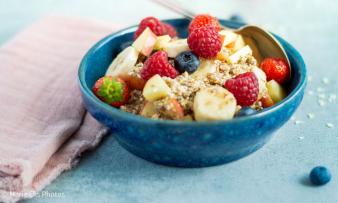
Das Erb-Müesli plus Haferflocken ist Rohkost, vegan, also laktosefrei, aber auch glutenfrei. Ein besonders gesundes veganes Frühstück als Brotersatz.
Die Gurken-Rollen mit "Ziegenkäse" und Minz-Sauce halten sich überraschend gut. Sie sind ideal für Apéro oder Fingerfood. (Minze, Minzen)

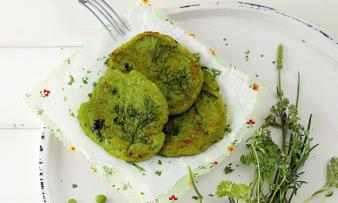
Erbsenpfannkuchen bekommen mit der getrockneten Chili Paprika eine besondere Note. Varianten mit Curry, Kräutern oder Limettensaft